

Navigating the world of investments can feel like deciphering a complex code, but what if you had a secret weapon to simplify it all? That’s precisely what a calculator for investing offers. Whether you’re a seasoned investor or just starting, leveraging the right tools can demystify potential returns, illustrate the power of compounding, and help you make informed financial decisions. Understanding how these calculators work is not just about crunching numbers; it’s about gaining clarity and confidence in your financial future. This comprehensive guide will equip you with the knowledge to effectively use a calculator for investing to maximize your profits and achieve your long-term goals.

Why a Calculator for Investing is Your Financial Superpower
In the intricate landscape of personal finance, a calculator for investing acts as a vital compass. It transforms abstract financial concepts into tangible projections, allowing you to visualize your money’s growth. These tools are highly valuable for anyone serious about building wealth.
Understanding Compounding
Compound interest is often called the “eighth wonder of the world” for good reason. It’s the process where your earnings on an investment also begin to earn money, leading to exponential growth. A good investment calculator can graphically demonstrate how a modest initial investment, combined with regular contributions, can grow significantly over decades, thanks to this powerful effect. It’s crucial to start early to fully harness compounding’s potential.
Planning for Retirement
Retirement planning is one of the most common and critical uses for investment calculators. These tools allow you to input your current age, desired retirement age, current savings, and expected contributions. They then project how much you’ll have saved, helping you determine if you’re on track or if adjustments are needed. This foresight empowers you to make proactive decisions about your savings rate and investment choices.
Debt Management Insights
While primarily for investments, many calculators can also help understand debt. By seeing how much interest you’ll pay over the life of a loan, these tools can help illustrate the benefits of prioritizing paying off high-interest debts sooner. Understanding the total cost of debt through a calculator can free up more capital for investing in the long run.
Types of Investment Calculators and Their Uses
There isn’t just one type of investment calculator; rather, there’s a suite of tools, each designed for a specific financial purpose. Knowing which one to use for what scenario is key to effective financial planning.
- Compound Interest Calculator: This foundational tool shows how your money grows over time, factoring in your initial investment, regular contributions, interest rate, and time horizon. It’s excellent for demonstrating the power of long-term investing.
- Retirement Savings Calculator: More specific than a general compound interest calculator, these tools help project your nest egg by retirement age, often incorporating inflation and withdrawal rates. For insights into saving for retirement, resources like Fidelity offer valuable calculators and articles.
- ROI (Return on Investment) Calculator: Used to assess the profitability of an investment. It helps you understand the efficiency of your investment by comparing the gain or loss relative to its cost.
- Loan/Mortgage Calculator: While not strictly for “investing” in the traditional sense, understanding your loan payments can free up funds for investments. These calculate monthly payments, total interest paid, and amortization schedules.
- Savings Goal Calculator: If you have a specific financial goal, like a down payment for a house or a child’s education, this calculator helps you determine how much you need to save periodically to reach that target.
- Inflation Calculator: Crucial for understanding the future purchasing power of your money. It helps you see how much more you might need to save to maintain your current lifestyle in the future. The U.S. Treasury Department provides resources for understanding economic factors like inflation.

How to Effectively Use a Calculator for Investing
Using these tools doesn’t require advanced math skills. It’s about providing accurate inputs and understanding the outputs. Here’s a practical guide to getting the most out of your calculator for investing.
Practical “How to Calculate” Section
When you use an online investment calculator, you’ll typically input a few key pieces of information. The calculator then does the complex work for you. Here’s how it generally works without needing to understand intricate formulas:
- Start with Your Initial Investment: This is the lump sum you begin with.
- Add Regular Contributions: Input how much you plan to add periodically (e.g., monthly, annually).
- Specify the Investment Horizon: This is the number of years you plan to keep your money invested.
- Estimate Your Annual Rate of Return: This is the average percentage growth you expect from your investments. Be realistic; historical stock market returns average around 7-10% annually, but past performance doesn’t guarantee future results.
- Consider Compounding Frequency: Most calculators assume monthly or annual compounding, which impacts how often your earnings start earning interest themselves.
After entering these details, the calculator will instantly show you your projected future value. This simple process allows anyone to visualize potential growth. For more detailed financial analysis, you can consult sites like Bloomberg for market data and economic insights.
Monthly Payment Calculator
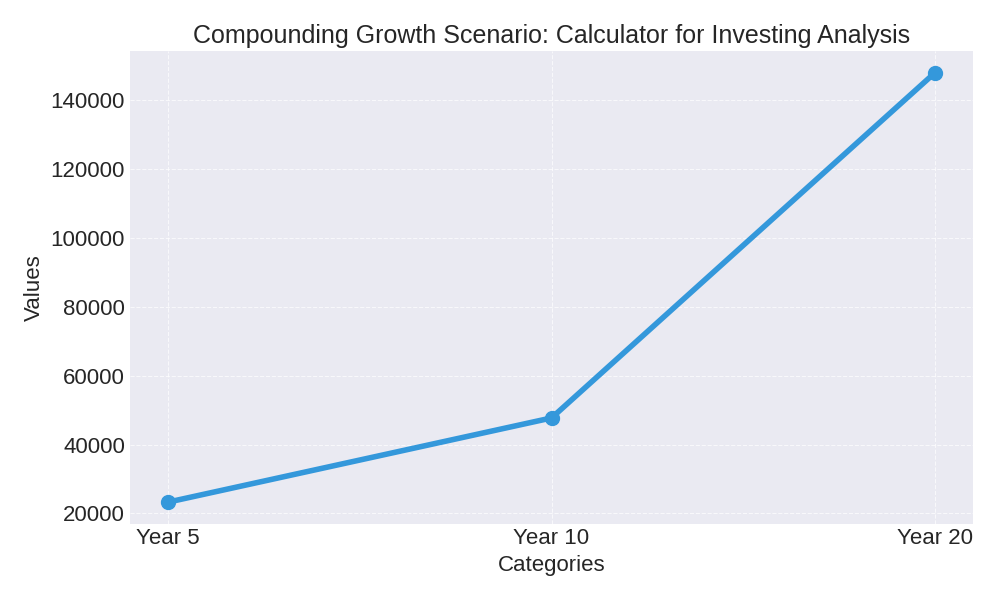
Compound Growth Scenario: Visualizing Your Future
To truly appreciate the power of compounding, let’s look at a hypothetical scenario. Imagine an initial investment of $5,000, with monthly contributions of $200, earning an average annual return of 8%.
| Time Horizon | Total Contributions | Projected Value |
|---|---|---|
| Year 5 | $17,000 | $23,280 |
| Year 10 | $29,000 | $47,720 |
| Year 20 | $53,000 | $147,940 |
As you can see, the projected value grows significantly beyond just the contributions, demonstrating the undeniable power of compounding over time. This table underscores why using an investment calculator is so valuable for long-term planning.
Common Pitfalls and How to Avoid Them
While incredibly useful, investment calculators are only as good as the information you feed them. Being aware of potential pitfalls can help you get more accurate and realistic projections.
- Ignoring Inflation: It’s important to consider future values in “real” (inflation-adjusted) terms, especially for long-term goals.
- Overly Optimistic Returns: It’s tempting to plug in high expected returns, but it’s generally advisable to be realistic. Using conservative estimates can help in creating a more achievable financial roadmap.
- Forgetting Fees and Taxes: Investment fees (e.g., expense ratios, trading fees) and taxes on gains can significantly erode returns. It’s advisable to factor these into your calculations where possible.
- Inconsistent Contributions: Life happens, and sometimes regular contributions are difficult. While calculators provide projections based on consistent inputs, understand that your real-world journey may vary.
- Not Reviewing Periodically: Financial circumstances change. Your income, expenses, and goals evolve. It’s beneficial to revisit and update your calculator projections regularly, perhaps once a year.

Frequently Asked Questions (FAQ)
What is the most important input for an investment calculator?
While all inputs are crucial, the time horizon and the expected annual rate of return often have the most significant impact on the final projected value, especially over long periods. Even small differences in these can lead to large variations.
Are investment calculator results guaranteed?
No, calculator results are projections based on inputs and historical averages, not guarantees. The stock market is dynamic, and actual returns can vary significantly. They are best used for planning and understanding potential outcomes.
Can I use these calculators to compare different investment options?
Absolutely! You can run multiple scenarios, adjusting the expected rate of return for different asset classes (e.g., bonds vs. stocks) or different investment vehicles. This helps you compare potential growth and risk profiles.
Should I use a professional financial advisor in addition to calculators?
Yes, calculators are powerful tools for self-education and planning, but they don’t replace personalized advice. A qualified financial advisor can provide tailored strategies, consider your unique tax situation, and help with complex financial planning. For finding a financial advisor, resources from the U.S. Securities and Exchange Commission are a good starting point.
Conclusion
A calculator for investing is far more than a simple numerical tool; it’s an empowerment device. It allows you to visualize your financial future, understand the profound impact of time and compounding, and make more confident, data-driven decisions. By understanding its functions and avoiding common pitfalls, you can harness its power to maximize your profits and achieve your financial aspirations. Start experimenting with these valuable tools today.
Disclaimer: The information provided in this article is for educational purposes only and does not constitute financial advice.