

Are you tired of feeling overwhelmed by financial jargon, making investment decisions based on fleeting headlines, or watching your hard-earned money barely keep pace with inflation? You’re not alone. Many individuals struggle to navigate the complex world of finance, often making choices that prioritize short-term gains over sustainable, long-term wealth creation. It’s time to shift your approach from hopeful speculation to strategic design with intelligent investing.
This isn’t about secret formulas or insider trading; it’s about a disciplined, informed approach that empowers you to take control of your financial future. We’re cutting through the noise to give you the actionable insights you need for genuinely smart growth. When you embrace intelligent investing, you move beyond mere participation and become a proactive architect of your financial destiny.

Stop Guessing, Start Growing: The Core of Intelligent Investing
True intelligent investing means abandoning the reactive mindset for a proactive, goal-oriented strategy. It’s about making decisions based on data, understanding your personal financial landscape, and consistently applying proven principles. This shift in perspective is what separates those who merely invest from those who invest wisely.
Insider Tip: Your greatest investment enemy isn’t the market; it’s often your own emotions. Panic selling during downturns or chasing hot stocks based on hype are classic pitfalls that sabotage long-term growth. Stick to your plan, even when it feels uncomfortable.
Diversification: Your First Line of Defense
Think of diversification not as a way to maximize every single gain, but as a crucial strategy to minimize risk. Spreading your investments across different asset classes (stocks, bonds, real estate), industries, and geographies ensures that a downturn in one area doesn’t decimate your entire portfolio.
Common Myth to Avoid: “Putting all your eggs in one basket offers bigger returns.” While a concentrated bet can pay off spectacularly, it dramatically increases your risk of catastrophic loss. Diversification aims for consistent, sustainable growth, protecting you from single points of failure.
Decoding Risk: It’s Not What You Think
Risk isn’t a four-letter word to be avoided entirely; it’s an inherent part of investing that needs to be understood and managed. Your personal risk tolerance – your ability and willingness to endure potential losses for greater gains – is the bedrock of your investment strategy.
But risk goes beyond market volatility. You also face inflation risk (your money buying less over time), interest rate risk (changes affecting bond values), and even longevity risk (outliving your savings). Intelligent investors consider all these factors.
The Power of Compounding: Your Secret Weapon
Albert Einstein reportedly called compound interest the “eighth wonder of the world.” It’s simple yet incredibly powerful: your earnings generate their own earnings. This snowball effect is the primary driver of wealth creation over time, turning modest contributions into substantial sums.
How to Calculate Compound Growth (The Easy Way)
Understanding compound growth doesn’t require complex formulas. Imagine you start with $1,000 in an investment that grows by 10% each year. In the first year, you earn $100, bringing your total to $1,100. The magic happens in year two: that 10% growth now applies to the new total of $1,100, earning you $110. Your balance becomes $1,210. Each year, your investment grows not just on your initial money, but also on all the accumulated earnings.
The key is consistency and time. The longer your money has to compound, the more significant the growth becomes, especially with regular additional contributions.
Monthly Payment Calculator
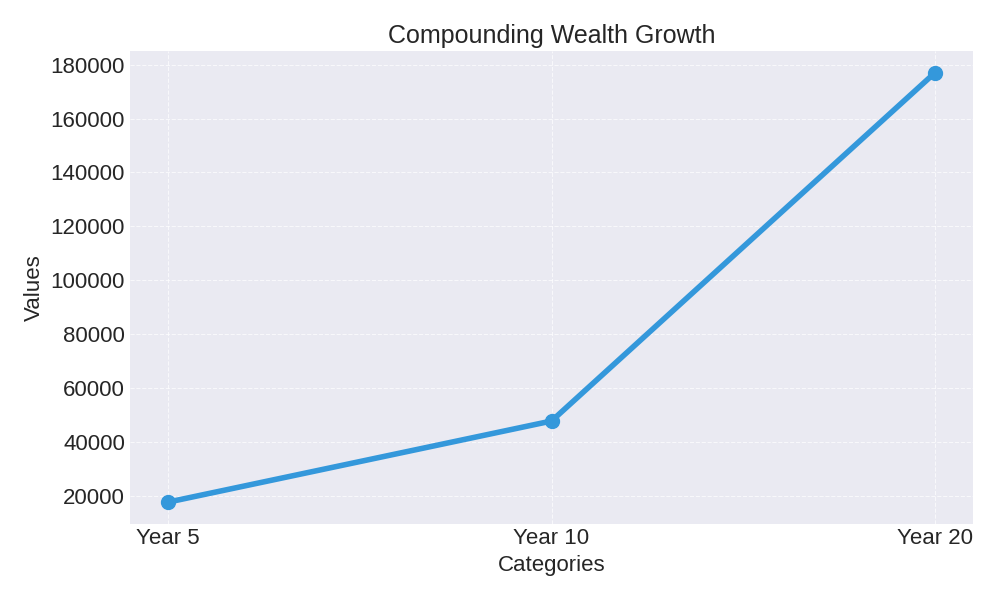
Here’s a clear example of how compounding can dramatically increase your wealth over time, even with a modest starting point and regular contributions:
| Investment Period | Initial + Contributions | Estimated Total Value* |
|---|---|---|
| Year 5 | $15,000 | $17,623 |
| Year 10 | $30,000 | $47,725 |
| Year 20 | $60,000 | $176,980 |
*Assumes an initial investment of $3,000, annual contributions of $3,000, and an average annual return of 7%.

Common Myths to Avoid in Intelligent Investing
The financial world is rife with misconceptions that can derail even the best intentions. As a strategic investor, you need to arm yourself with accurate information and a healthy dose of skepticism.
- Myth: You can “time the market.” Trying to predict market highs and lows is a fool’s errand, even for seasoned professionals. A consistent, long-term approach of buying and holding or dollar-cost averaging almost always outperforms attempts to time entries and exits.
- Myth: Get-rich-quick schemes are viable. If it sounds too good to be true, it almost certainly is. Sustainable wealth is built through patience, discipline, and consistent effort, not overnight gambles.
- Myth: Only experts can succeed. While professional advice is invaluable, the core principles of intelligent investing are accessible to everyone. With a basic understanding and a commitment to learning, you can build and manage a successful portfolio.
Building Your Intelligent Investment Portfolio
Constructing a robust portfolio involves more than just picking stocks. It requires thoughtful asset allocation – deciding how to divide your investments among different categories like stocks, bonds, and cash, based on your age, goals, and risk tolerance. For most long-term investors, low-cost index funds and Exchange Traded Funds (ETFs) offer excellent diversification and tend to outperform actively managed funds over time. Vanguard is a well-known example offering a wide range of such options; you can learn more about their offerings at Vanguard.com.
Regularly reviewing and rebalancing your portfolio (bringing your asset allocation back to its original targets) is also critical to maintain your desired risk level and alignment with your financial goals.
The Behavioral Edge: Mastering Your Mindset
This is where many investors falter. Your psychology plays a massive role in your investment success. Fear and greed can lead to poor decisions – selling low during market downturns or buying high during speculative bubbles. Developing a strong, disciplined mindset is as important as understanding market fundamentals.
Learning to detach your emotions from your investment decisions and sticking to a predefined plan, even amidst market turmoil, is a powerful behavioral edge. Understanding concepts from behavioral economics can help you recognize and counteract your own cognitive biases. For deeper insights into the psychology of money, explore resources like those at Psychology Today.
Continuous Learning and Adaptation
The financial world is dynamic. While core principles remain constant, market conditions, economic landscapes, and your personal circumstances will evolve. An intelligent investor commits to continuous learning and periodic reassessment of their strategy. Stay informed, but don’t react impulsively to every news cycle.
Regularly checking your understanding of financial concepts and market trends is important. For reliable, unbiased information and investor education, government resources like the Securities and Exchange Commission (SEC) are invaluable. Visit SEC.gov to access their extensive investor guides and publications.

Conclusion
Embracing intelligent investing isn’t about chasing the next hot stock; it’s about building a durable framework for your financial future. By understanding the power of diversification, mastering your emotional responses, harnessing compound growth, and committing to continuous learning, you transform yourself from a passive observer into an active, empowered decision-maker. This strategic approach empowers you to navigate market fluctuations with confidence and stay on track toward your long-term wealth goals.
Ready to Take Control?
The time to start making smarter financial decisions is now. Don’t let fear or inertia dictate your financial path. Evaluate your current investment strategy, educate yourself on the principles of intelligent investing, and if needed, consult with a qualified financial advisor to tailor a plan that aligns with your unique aspirations. Your future self will thank you for taking these critical steps today.
Disclaimer: The information provided in this article is for educational purposes only and does not constitute financial advice.