

The future isn’t just coming; it’s accelerating at an unimaginable pace, driven by technologies like quantum computing. For forward-thinking investors, understanding quantum computer investing isn’t just about spotting the next big trend; it’s about positioning portfolios for potentially exponential growth. This guide will demystify the complex world of quantum computing and provide a clear, actionable roadmap for investors seeking to capitalize on this trillion-dollar opportunity. We’ll explore core concepts, identify key investment avenues, and outline strategies to navigate the nascent but immensely promising landscape of quantum technology.
The core message is clear: quantum computing is a nascent but incredibly powerful technology poised to revolutionize numerous industries. While high-risk, a strategic approach to quantum computer investing now could unlock significant long-term rewards. Diversification, thorough due diligence, and a focus on companies with strong intellectual property and talent are paramount.

Understanding Quantum Computing: The Core Technology
At its heart, quantum computing harnesses the bizarre rules of quantum mechanics to solve problems classical computers simply cannot. Instead of bits (0s or 1s), quantum computers use qubits, which can be 0, 1, or both simultaneously (superposition), and can be linked through entanglement. This allows them to process vast amounts of information in parallel, dramatically accelerating calculations for certain types of problems. It’s like having a computer that can explore millions of solutions at once, rather than one by one.
Why this matters in real life: Imagine drug companies trying to design new medications. A classical supercomputer might take years to simulate complex molecular interactions to find a new drug candidate; a quantum computer could potentially do it in days or even hours. This could slash research and development costs by millions, bring life-saving drugs to market much faster, and fundamentally change healthcare. It’s about solving previously intractable problems that hinder human progress and innovation.
Investment Avenues in Quantum Computing
Navigating the quantum landscape requires understanding where investment opportunities truly lie. You can approach quantum computer investing through direct plays in companies building the technology, or indirectly through industries that will benefit immensely from its adoption. Both strategies offer unique risk-reward profiles for investors.
Direct Investment: Pure-Play Quantum Companies
These are companies primarily focused on developing quantum hardware, software, or services. Investing here means betting directly on the success of the underlying technology and its commercialization. Think of companies like IonQ (NASDAQ: IONQ), one of the first pure-play quantum computing companies to go public, or established tech giants like IBM, which has a significant quantum division. For example, IBM has made its quantum processors accessible via the cloud, allowing researchers and developers worldwide to experiment with quantum algorithms. This direct access is crucial for accelerating development and adoption.
Why this matters in real life: If you invest in a company that invents a breakthrough quantum chip or a widely adopted quantum algorithm, your investment could see substantial, even exponential, returns. However, these investments are often highly volatile and subject to intense competition, technological hurdles, and the very early stage of the market. Success is not guaranteed, but the potential upside is significant.
Indirect Investment: Enablers and Beneficiaries
This strategy involves investing in companies that will leverage quantum computing, or those that provide essential components for its development. Consider sectors like advanced materials for quantum processors, specialized cryogenic cooling systems, or even cybersecurity firms developing quantum-resistant encryption. For instance, a pharmaceutical company that heavily invests in AI-driven drug discovery could see its R&D turbocharged by future quantum capabilities. They might not build quantum computers, but they’ll be major users, gaining a significant competitive edge through quantum-enhanced simulations and data analysis.
Why this matters in real life: This approach often offers a potentially safer entry point, as these companies often have existing revenue streams and market positions independent of quantum’s immediate success. Their growth could be boosted by quantum tech without being solely dependent on its immediate commercialization. It’s a way to participate in the quantum revolution with potentially lower direct exposure to its inherent volatility.

The Risks and Rewards of Quantum Investment
Like any frontier technology, quantum computing presents both substantial risks and potentially enormous rewards. The technology is still in its infancy, and a “quantum winter” – a period of slowed progress or funding – is always a possibility. Significant capital is required for research and development, and the path to widespread commercial adoption is long and uncertain. However, the potential for disruptive innovation across multiple industries is immense, making it a compelling long-term bet for those with a high-risk tolerance.
Scenario: Imagine investing $5,000 in a promising quantum startup today. In a high-growth scenario, if the company develops a universally adopted quantum algorithm or a scalable quantum processor, that investment could potentially grow into $50,000 to $100,000 within a decade. Conversely, if the technology faces unforeseen roadblocks, fierce competition, or the company fails to execute its vision, the investment could drop significantly, even to zero. This high-risk, high-reward profile underscores the importance of a thoughtful and diversified investment strategy.
Building Your Quantum Investment Strategy
A prudent approach to quantum computer investing involves thorough research, diversification, and a long-term perspective. This isn’t a get-rich-quick scheme, but rather an investment in a foundational technology that will unfold over decades. Patience will be a key virtue for investors in this space.
How to Evaluate Quantum Companies
When looking at potential quantum investments, consider several critical factors beyond just market hype. These elements can indicate a company’s underlying strength and long-term viability:
- Intellectual Property: Does the company hold strong patents in key quantum areas? Robust patents protect their innovations from competitors and provide a competitive moat.
- Talent Pool: Are they attracting and retaining top quantum physicists, engineers, and computer scientists? Expert talent is scarce and is the lifeblood of innovation in this field.
- Partnerships: Are they collaborating with major universities, government agencies, or large corporations? Strategic partnerships validate their technology, provide resources, and open doors to commercialization. For comprehensive financial reports of public companies, resources from the U.S. Securities and Exchange Commission are indispensable. Major technology companies like IBM are at the forefront of quantum development. You can learn more about their advancements and commercial applications by visiting their official pages, such as IBM’s quantum computing hub.
- Roadmap and Funding: Do they have a clear, achievable plan for scaling their technology and sufficient funding to execute it over many years? Quantum development is capital intensive.
Why this matters in real life: Investing in a company with robust IP, strong partnerships, and top talent means you’re backing a more resilient and potentially successful enterprise. These factors significantly reduce the risk of being outmaneuvered by competitors and increase the likelihood of bringing commercially viable products to market.
Calculating Potential Growth: A Simple Scenario
While predicting exact returns in emerging tech is impossible, we can illustrate potential growth with a simplified scenario. Don’t worry about complex mathematical formulas; think about the power of compounding. Imagine you invest a starting amount, say $1,000, into a well-diversified portfolio of quantum-related stocks. Let’s assume a hypothetical average annual growth rate, for instance, 10%.
To estimate your potential future value, you simply take your starting investment and multiply it by (1 + growth rate) for each passing year. For example, if you invest $1,000 at a 10% annual growth rate:
- Year 1: $1,000 multiplied by 1.10 equals $1,100
- Year 2: $1,100 multiplied by 1.10 equals $1,210
And so on. This calculation demonstrates how your initial investment grows, with earnings from previous years also earning returns. This simple process illustrates the powerful concept of compound interest, where your money earns returns on both your initial investment and the accumulated interest from prior periods. The longer you stay invested, the more significant the compounding effect becomes.
Quantum Investment Growth Estimator
Project potential exponential growth for your quantum tech investments.
Why this matters in real life: Understanding this basic concept helps you appreciate the long-term benefit of consistent investing, even if the numbers are illustrative. It highlights that patience and reinvestment are key drivers of wealth accumulation, especially in high-growth potential sectors like quantum computing. While actual results will vary widely, the principle remains the same.
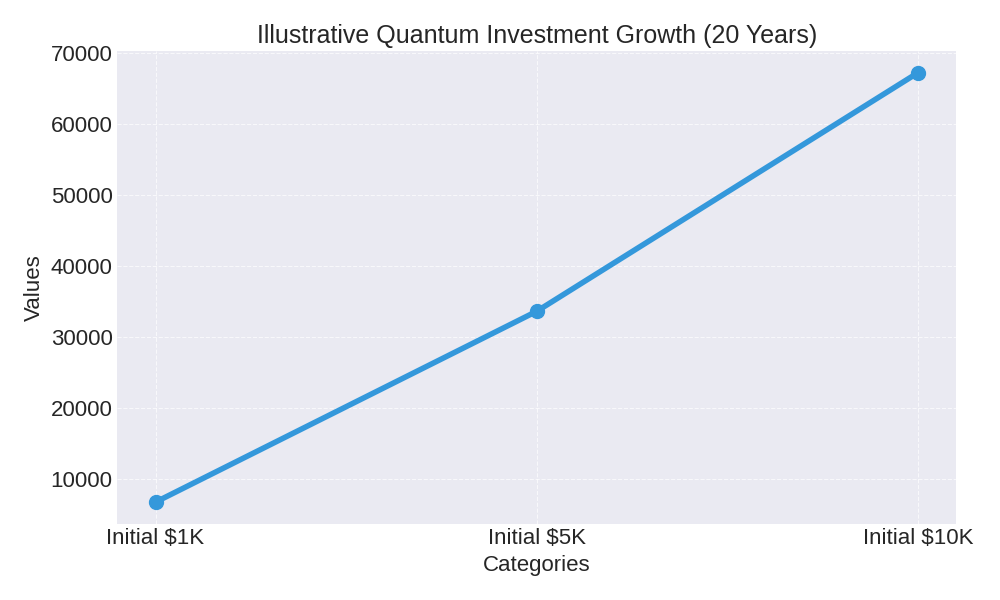
| Initial Investment | Estimated Value (Year 10) | Estimated Value (Year 20) |
|---|---|---|
| $1,000 | $2,594 | $6,727 |
| $5,000 | $12,972 | $33,637 |
| $10,000 | $25,937 | $67,275 |
Note: These values are illustrative examples assuming a hypothetical 10% average annual growth rate and do not account for taxes, fees, or inflation. Actual returns will vary significantly based on market performance, company success, and other economic factors.

Frequently Asked Questions About Quantum Computer Investing
Q: Is it too early to invest in quantum computing?
A: While the technology is certainly emerging, early investment can offer significant upside if chosen wisely. It’s crucial to acknowledge the higher risk associated with nascent industries. For a balanced portfolio, consider allocating a smaller, speculative percentage to such high-growth, high-risk areas.
Q: How can I research quantum companies effectively?
A: Look for comprehensive financial reports (such as 10-K and 10-Q filings for public companies) via the SEC website. Explore their patent portfolios, academic publications, and news from reputable technology and business journals. Government sources like the National Institute of Standards and Technology (NIST.gov) provide valuable insights into quantum standards, research initiatives, and future directions.
Q: What are the biggest risks specific to quantum investments?
A: Key risks include technological breakthroughs failing to materialize as expected, intense competition from well-funded rivals, regulatory uncertainty in a new domain, and the significant capital required for continuous research and development. There’s also the risk of a “quantum winter,” where funding and market interest might wane before widespread commercialization, leading to prolonged underperformance.
Conclusion and Call to Action
Quantum computer investing is not for the faint of heart, but for those with a long-term vision and a willingness to understand a complex field, it presents an unparalleled opportunity. The quantum revolution promises to redefine industries, solve previously unsolvable problems, and potentially create immense wealth for early, strategic investors. By carefully researching, diversifying your portfolio, and staying informed about technological advancements, you can position yourself to potentially benefit from this next frontier of innovation.
Don’t chase headlines; instead, build a strategy based on solid understanding and patience. Ready to explore this revolutionary market? Start your due diligence today and consider how quantum technology could fit into your investment portfolio. Consult a qualified financial advisor to tailor a strategy that aligns with your individual risk tolerance and financial goals, ensuring a personalized approach to this exciting new frontier.
Disclaimer: The information provided in this article is for educational purposes only and does not constitute financial advice.