
The digital age has opened new frontiers for wealth creation, and cryptocurrency investing stands out as one of the most talked-about. It’s a rapidly evolving space that offers exciting opportunities, but also presents significant risks. Navigating this landscape successfully requires a smart, informed approach.
This guide will equip you with the knowledge to approach cryptocurrency investing strategically, helping you understand the underlying technology, mitigate risks, and build a resilient portfolio. We’ll demystify complex concepts and provide actionable steps to help you on your financial journey.

Understanding the Cryptocurrency Landscape
At its heart, cryptocurrency is a form of digital money designed to be secure and, in many cases, anonymous. It operates on a technology called blockchain, a decentralized ledger system. This means no single entity, like a bank or government, controls it.
Why does this matter in real life? Imagine sending money directly to a friend across the world without needing a bank or payment processor. Blockchain technology makes this possible, often with lower fees and faster transaction times than traditional methods. It brings transparency and immutability to transactions, meaning once a transaction is recorded, it cannot be altered.
For example, if you send Bitcoin, that transaction is added to a chain of blocks, visible to anyone, but your personal identity remains pseudonymized. This transparency builds trust in the system. The U.S. Securities and Exchange Commission (SEC) provides further insights into understanding digital assets and their regulations.
The Core Principles of Smart Cryptocurrency Investing
Approaching crypto with a disciplined mindset is crucial. The market is known for its volatility, meaning prices can fluctuate wildly in short periods. Therefore, sound principles are your best defense against impulsive decisions.
- Education is Key: Before investing a single dollar, commit to learning. Understand the technology behind different cryptocurrencies, read their whitepapers, and research the development teams. This due diligence helps you differentiate between genuine innovation and speculative hype.
- Risk Management: Only invest what you can comfortably afford to lose. Cryptocurrency markets are highly speculative, and there’s a real possibility of losing your entire investment. Treat it as a high-risk, high-reward component of a diversified portfolio.
- Diversification: Don’t put all your eggs in one basket. Spreading your investment across several different cryptocurrencies, or even across different asset classes (like stocks, bonds, and real estate), reduces overall portfolio risk. Imagine investing equally in Bitcoin, Ethereum, and a stablecoin; this balance helps buffer against sharp declines in a single asset.

Building Your Cryptocurrency Investment Strategy
A structured approach to cryptocurrency investing can significantly improve your chances of success. Follow these steps to build a robust strategy tailored to your financial situation.
Step 1: Define Your Goals and Risk Tolerance
Before you invest, clearly define what you hope to achieve. Are you saving for a short-term goal, like a down payment on a house, or a long-term goal, such as retirement? Your time horizon will influence the level of risk you can afford to take.
Why does this matter? If you need your funds in a year, a highly volatile asset might not be suitable. If you have decades, you might tolerate more risk for potentially higher returns. Be honest about how much market fluctuation you can handle emotionally without panicking and selling at a loss.
Step 2: Research and Due Diligence
Thorough research is non-negotiable. Look beyond the price charts and delve into the project’s fundamentals. Evaluate its utility, adoption, community support, and the strength of its underlying technology.
Why does this matter? This separates projects with real-world applications from those built on speculation. A valuable resource for broader market trends and news can be found at reputable financial news outlets like Bloomberg.
Step 3: Choose the Right Platform
Selecting a secure and reputable cryptocurrency exchange is vital. Look for platforms with strong security measures, competitive fees, and a wide range of assets. Ensure they are regulated in your jurisdiction, if applicable.
For example, using a well-established exchange with a track record of security and customer service is generally safer than an unknown platform. Check for features like two-factor authentication (2FA) and cold storage of assets.
Step 4: Start Small and Dollar-Cost Average (DCA)
Don’t feel pressured to invest a large sum all at once. Starting with a smaller amount allows you to learn the ropes without significant financial exposure. Dollar-Cost Averaging (DCA) is a powerful strategy where you invest a fixed amount of money at regular intervals, regardless of the asset’s price.
Why does this matter? DCA reduces the impact of market volatility. Instead of trying to “time the market,” which is nearly impossible, you average out your purchase price over time. For example, investing $100 every month for a year is often less risky than investing $1200 all at once.
Step 5: Secure Your Assets
Security is paramount in cryptocurrency. Utilize strong, unique passwords and always enable two-factor authentication (2FA) on your exchange accounts. Consider moving larger holdings to a hardware wallet (cold storage) for enhanced security.
Why does this matter? Hot wallets (online) are more susceptible to hacking than cold wallets (offline). Protecting your digital keys is equivalent to protecting physical cash.
Step 6: Monitor and Rebalance
Regularly review your portfolio’s performance and adjust it as necessary. Market conditions change, and your investment goals might evolve. Rebalancing involves selling some assets that have grown significantly and buying more of those that have underperformed, to maintain your desired asset allocation.
Why does this matter? This active management prevents your portfolio from becoming too concentrated in one area and helps you stay aligned with your original risk tolerance.
How to Calculate Potential Compound Growth
Understanding compound growth is key to appreciating long-term investment potential. Compounding means earning returns not only on your initial investment but also on the accumulated returns from previous periods. It’s often called “interest on interest” and can dramatically boost your wealth over time.
Imagine you invest $1,000, and it grows by 10% in the first year. You now have $1,100. In the second year, that 10% growth applies to the new total of $1,100, not just the original $1,000. So, you’d earn $110, bringing your total to $1,210. This snowball effect accelerates over decades, making time your biggest ally in investing.
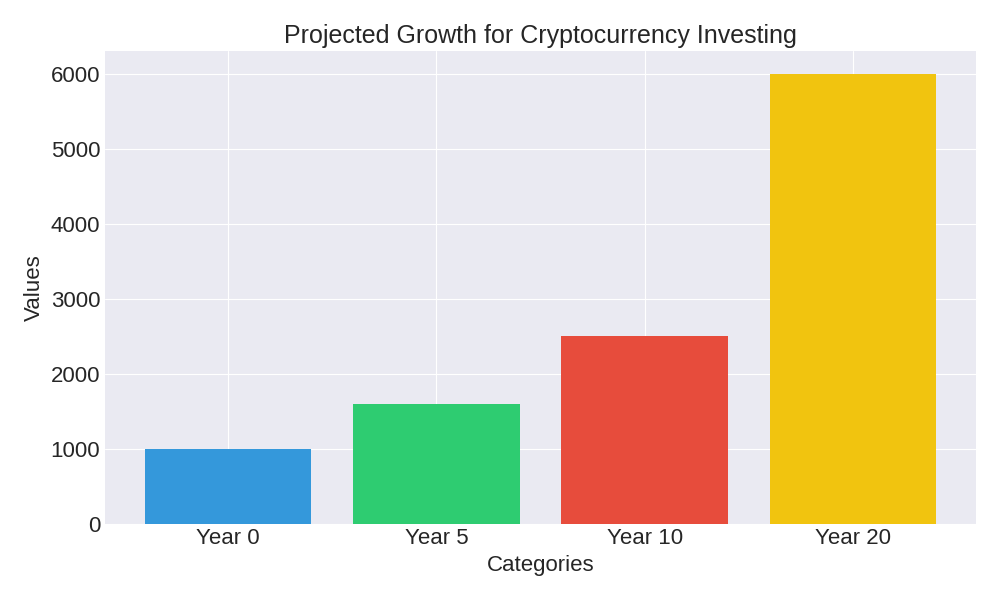
While exact returns in cryptocurrency are unpredictable, this concept shows how even modest, consistent growth can lead to substantial wealth. This table illustrates a hypothetical compound growth scenario:
| Year | Initial Investment ($) | Projected Value ($) |
|---|---|---|
| 0 | 1,000 | 1,000 |
| 5 | 1,000 | Approximately 1,600 – 2,000 |
| 10 | 1,000 | Approximately 2,500 – 4,000 |
| 20 | 1,000 | Approximately 6,000 – 16,000+ |
(Note: These are illustrative ranges for a hypothetical annual growth rate and do not represent actual or guaranteed returns.)
Cryptocurrency Investment Growth Calculator
Navigating Risks and Regulations
The cryptocurrency market, while exciting, comes with inherent risks. Awareness of these is crucial for responsible investing.
- Volatility: Prices can swing dramatically within hours. A mini case study might involve a lesser-known altcoin experiencing a 50% drop in value after an initial surge, wiping out gains for many investors who didn’t understand the underlying project’s risks. This underscores the need for diversification and caution.
- Security Concerns: The digital nature of crypto makes it a target for hackers and scammers. Phishing attempts, fraudulent exchanges, and malware are constant threats. Always be vigilant about where you store your assets and how you access your accounts.
- Regulatory Landscape: Regulations around cryptocurrencies are still evolving and vary significantly by country and region. This uncertainty can impact market stability and asset classification. For consumer protection information related to digital assets, you can refer to resources from organizations like FINRA.
Why does this matter? Understanding these risks helps you implement stronger security measures, make informed decisions about project viability, and prepare for potential regulatory shifts. It protects your capital and peace of mind.

Frequently Asked Questions (FAQ)
What’s the best cryptocurrency to invest in?
There isn’t a single “best” cryptocurrency, as the ideal choice depends on your individual goals and risk tolerance. Major cryptocurrencies like Bitcoin and Ethereum are generally considered less volatile than newer, smaller altcoins, but they still carry significant risk. Always conduct your own research.
How much money do I need to start investing in crypto?
You can start with a very small amount, even as little as $10 or $50, on many platforms. This accessibility makes it easy to begin with Dollar-Cost Averaging. The key is to start with an amount you are comfortable losing.
Is cryptocurrency investing safe?
Cryptocurrency investing carries significant risks, including market volatility, potential for fraud, and evolving regulations. While the underlying blockchain technology is secure, the platforms and methods used to buy, sell, and store crypto can be vulnerable. It is considered a high-risk investment.
How do I pay taxes on crypto?
Tax laws regarding cryptocurrency vary by jurisdiction. In many countries, including the U.S., cryptocurrency is treated as property for tax purposes. This means you may owe capital gains tax when you sell, trade, or use crypto. It’s crucial to keep accurate records of all transactions and consult a tax professional for personalized advice.
Conclusion
Cryptocurrency investing offers a compelling opportunity for wealth growth, but it is not without its complexities and risks. By adopting a disciplined approach rooted in education, strategic planning, and rigorous risk management, you can navigate this dynamic market more effectively. Remember that patience and continuous learning are your greatest assets in this journey.
Start Your Informed Crypto Journey Today
Are you ready to explore the world of digital assets responsibly? Begin by educating yourself, defining your financial goals, and consulting with a qualified financial advisor. Take the first step towards building a smart and resilient investment portfolio.
Disclaimer: The information provided in this article is for educational purposes only and does not constitute financial advice.