
In the evolving landscape of personal finance, traditional investments like stocks and bonds have long been the bedrock of many portfolios. However, smart investors are increasingly looking beyond these conventional avenues. The secret to enhancing diversification and potentially boosting returns lies in investing in alternative assets. This comprehensive guide will demystify alternative assets, explain their benefits, and provide actionable steps for incorporating them into your financial strategy.
Alternative assets are investments that fall outside the typical publicly traded stocks, bonds, and cash. They can include everything from real estate and private equity to commodities, hedge funds, and even art or wine. For investors seeking to truly diversify and hedge against market volatility, understanding and then investing in alternative assets is a crucial next step. This approach can open doors to unique growth opportunities not always tied to the broader stock market’s whims.

What Exactly Are Alternative Assets?
Alternative assets are simply investments that are not easily bought or sold on public exchanges. Think of them as the “road less traveled” in the investment world. Unlike shares of a major company you can buy with a few clicks, alternatives often require more specialized knowledge, longer holding periods, and sometimes, a higher entry point.
Why does this matter in real life? Imagine you own a portfolio entirely of tech stocks. If the tech sector takes a hit, your entire portfolio suffers. Now, imagine your portfolio also includes a piece of commercial real estate or a stake in a growing private company. These alternative assets might perform differently, cushioning the blow from the tech downturn. This independent movement is key to their value.
Beyond Stocks and Bonds: A Diverse Landscape
The universe of alternative assets is vast and varied. It extends far beyond what you might typically see in your brokerage account. Understanding this diversity is the first step toward strategic integration into your financial plan.
For example, instead of just investing in publicly traded company stocks, you could invest in a private startup. This type of investment typically offers different risk and return characteristics. It broadens your exposure to economic sectors and company growth stages that aren’t available on the public markets.
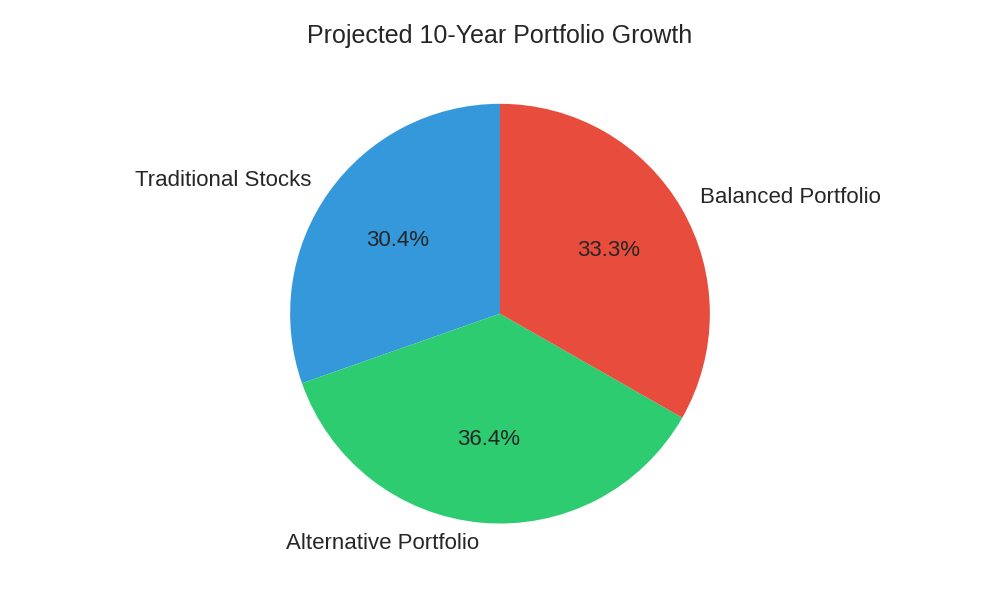
| Asset Class | Estimated Return Range (Annual Avg.) | Illustrative Value After 10 Years (from $10k) |
|---|---|---|
| Traditional Stock Portfolio | 5-10% | $16,289 – $25,937 |
| Diversified Alternative Portfolio | 7-12% | $19,671 – $31,058 |
| Balanced Portfolio (50% Trad./50% Alt.) | 6-11% | $17,908 – $28,394 |
Why Consider Alternative Assets in Your Portfolio?
The primary reasons investors turn to alternative assets are diversification, potential for higher returns, and inflation hedging. These benefits can significantly strengthen a portfolio, especially during uncertain economic times. They provide tools to achieve investment goals that might be out of reach with traditional assets alone.
Consider a scenario where the stock market experiences a significant downturn, as it has several times in history. If your portfolio relies solely on stocks, you would see a substantial loss. However, if a portion of your wealth is held in something like timberland or private debt, those assets might not be correlated with the stock market’s performance, thus providing stability.

Diversification and Risk Mitigation
One of the most compelling arguments for alternative assets is their ability to reduce overall portfolio risk. Many alternatives have a low correlation with traditional assets. This means when stocks go down, alternatives might hold their value or even go up.
For example, during the 2008 financial crisis, while many stock portfolios plummeted, some alternative investments like certain hedge funds or private real estate funds (depending on their strategy) offered a degree of protection. This non-correlation helps smooth out portfolio volatility, making your investment journey less bumpy.
Potential for Higher Returns
Alternative assets often come with the potential for higher returns compared to traditional investments, though this usually comes with higher risk and lower liquidity. Private equity, for instance, aims for outsized returns by investing in private companies that are not yet mature.
Imagine investing in a startup through a venture capital fund that later goes public or gets acquired. This can generate returns far exceeding what a typical blue-chip stock might offer. However, not all startups succeed, highlighting the increased risk involved. It’s about balancing this potential reward with careful due diligence.
Key Types of Alternative Assets to Explore
Exploring the diverse types of alternative assets is crucial for understanding your options. Each category has its unique risk-reward profile, liquidity characteristics, and investment mechanisms. Choosing the right ones depends on your financial goals and risk tolerance.
Real Estate (Direct & Indirect)
Real estate is perhaps the most well-known alternative asset. You can invest directly by buying properties (residential, commercial) or indirectly through Real Estate Investment Trusts (REITs) or private real estate funds. Direct ownership offers control but demands significant capital and management. REITs offer liquidity and diversification, often trading on exchanges like stocks.
Why this matters: Owning a rental property can provide steady income and potential appreciation, acting as a tangible asset that often hedges against inflation. For example, if you own a multi-family dwelling, you receive rent payments monthly, providing a consistent cash flow independent of daily stock market swings.
Private Equity & Venture Capital
Private equity involves investing in private companies not listed on a public stock exchange. Venture capital is a subset of private equity, focused on early-stage companies with high growth potential. These investments are typically made through specialized funds and require a long-term commitment.
Scenario: Imagine you contribute to a venture capital fund that invests in a promising biotech startup. If that startup develops a breakthrough drug and is acquired by a pharmaceutical giant five years later, your initial investment could multiply significantly. This offers a chance to participate in the growth of innovative companies before they become household names.
Hedge Funds
Hedge funds are professionally managed investment funds that use a variety of strategies to generate returns, often employing complex trading techniques and sometimes leveraging borrowed money. They are typically open only to accredited investors and often have high minimum investment requirements.
Why this matters: Hedge funds aim to generate positive returns regardless of whether the market is going up or down (absolute returns). They can use short-selling or arbitrage strategies to profit in various market conditions. This diversification of strategy can be a valuable addition to a traditional portfolio, offering a different source of potential gain.
Commodities
Commodities are raw materials like gold, silver, oil, natural gas, or agricultural products. You can invest in them directly (e.g., buying gold bullion) or indirectly through futures contracts, exchange-traded funds (ETFs), or commodity-focused mutual funds.
Example: During periods of high inflation, the value of traditional currency can erode. However, hard assets like gold or silver often maintain or even increase their value. If the price of crude oil spikes due to geopolitical events, investments in oil futures could see substantial gains, acting as a hedge against energy price inflation.
Collectibles & Fine Art
This category includes assets like fine art, rare wines, classic cars, stamps, or coins. Their value is often driven by scarcity, provenance, and cultural significance rather than economic fundamentals. These investments require expert knowledge for authentication and valuation.
Real-life example: A rare painting by a renowned artist could appreciate significantly over decades, becoming a valuable asset in an investor’s portfolio. Its value may not be directly tied to interest rates or corporate earnings, offering a unique form of diversification. However, finding a buyer for such unique items can take time.
Cryptocurrencies (A Modern Alternative)
Cryptocurrencies like Bitcoin and Ethereum represent a newer, highly volatile alternative asset class. They are digital or virtual currencies secured by cryptography, operating independently of a central bank. Their adoption and regulatory landscape are still evolving.
Why this matters: Cryptocurrencies offer potential for very high returns, driven by network effects and increasing adoption. They also represent a decentralized asset class, appealing to those looking for alternatives to traditional financial systems. However, their extreme price volatility means they carry significant risk and require careful consideration and understanding of the underlying technology.
How to Evaluate Alternative Investments
Evaluating alternative investments requires a different mindset than analyzing traditional stocks or bonds. You need to consider factors like illiquidity, valuation complexity, and the specific expertise required. Due diligence is paramount for these less transparent assets.
Understanding Liquidity Risks
Many alternative assets are illiquid, meaning they cannot be quickly converted into cash without a significant loss in value. Unlike a publicly traded stock, which you can sell instantly, selling a private equity stake or a piece of real estate can take months or even years.
This matters because you need to be comfortable locking up your capital for an extended period. Ensure that any funds allocated to alternative assets are truly long-term investments that you won’t need access to quickly.
Due Diligence is Crucial
Because alternative markets are less regulated and often less transparent, thorough due diligence is essential. This involves researching the asset itself, the fund managers, the underlying market, and the legal structures involved. Don’t rely solely on marketing materials.
For example, before investing in a private real estate fund, you would research the fund manager’s track record, the types of properties they acquire, their debt-to-equity ratios, and the specific market outlook for those properties. This ensures you understand exactly what you’re getting into.
The Role of Accreditation
Many alternative investments, particularly private equity, hedge funds, and venture capital, are only available to “accredited investors.” The U.S. Securities and Exchange Commission (SEC) defines an accredited investor as someone with a net worth over $1 million (excluding primary residence) or an annual income exceeding $200,000 ($300,000 for joint income) for the past two years, with the expectation of earning the same or more in the current year. This restriction is in place to protect less experienced investors from potentially complex and high-risk investments.
Practical “How to Calculate” Alternative Asset Performance
Calculating the performance of alternative assets can be more complex than for traditional assets due to irregular cash flows and less frequent valuations. However, a common method is to look at the Return on Investment (ROI).
To calculate ROI, you need to know your initial investment and the profit or loss from that investment. Let’s say you invest $50,000 in a private wine collection. After five years, you sell the collection for $65,000. Your profit is the selling price minus the initial investment, which is $15,000.
You then divide this profit by your initial investment. In our example, $15,000 divided by $50,000 equals 0.30. To express this as a percentage, you multiply by 100, giving you a 30% ROI over five years. This simple calculation helps you understand the direct financial return on your capital.
Alternative Asset Future Value Calculator
Common Challenges and Risks
While the benefits of investing in alternative assets are significant, it's crucial to acknowledge the challenges and risks involved. These investments are not a magic bullet and come with their own set of considerations.
Lack of Regulation and Transparency
Many alternative asset classes operate with less regulatory oversight than public markets. This can mean less standardized reporting, making it harder to evaluate performance and assess risk. For example, a private fund might not disclose its holdings or trading strategies with the same detail as a public mutual fund.
High Barriers to Entry
Accessing certain alternative investments often requires substantial capital. Private equity funds, for instance, might have minimum investment thresholds of hundreds of thousands or even millions of dollars. This can limit participation to accredited investors or institutions.
Illiquidity
As mentioned, most alternative assets are illiquid. You might not be able to sell your investment quickly, or you may incur significant penalties for early withdrawal from a fund. This can be a major challenge if you unexpectedly need access to your capital.
FAQ: Your Questions Answered About Investing in Alternative Assets
- Is investing in alternative assets only for the wealthy?
Historically, many alternative assets were exclusive to institutional investors and the ultra-wealthy. However, new platforms and pooled investment vehicles (like crowdfunding for real estate or fractional ownership of art) are making some alternative assets more accessible to everyday investors. Always check minimum investment requirements and investor qualifications.
- How do I get started with alternative assets?
Start by educating yourself thoroughly. Consider your risk tolerance and financial goals. For beginners, indirect investments like REITs or commodity ETFs can be a good starting point. For more direct and complex options, consult a qualified financial advisor who specializes in alternative investments. Reputable sources like the Financial Industry Regulatory Authority (FINRA) offer valuable investor education resources.
- What's the typical time horizon for these investments?
Most alternative assets are long-term investments, often requiring commitments of 5 to 10 years or even longer. This is particularly true for private equity, venture capital, and direct real estate. Plan your investments accordingly, ensuring you won't need the capital for other immediate needs.
- Are alternative assets always less risky than traditional ones?
Not necessarily. While they can offer diversification and potentially lower overall portfolio volatility, individual alternative assets can carry significant risks, including illiquidity risk, valuation risk, and operational risk. Their non-correlation to traditional markets doesn't automatically make them "safer."
Investing in alternative assets is no longer just for institutional players. With careful planning and education, individual investors can leverage these powerful tools to enhance their portfolios. By understanding the unique characteristics, benefits, and risks, you can make informed decisions that align with your long-term financial objectives.
Ready to explore these opportunities? Start by assessing your current financial situation, educating yourself further on specific alternative asset classes, and considering a consultation with a financial advisor experienced in this specialized field. Your financial future could be significantly strengthened by embracing the smart money secret.
Disclaimer: The information provided in this article is for educational purposes only and does not constitute financial advice.