

Tesla stock investing offers a unique opportunity to participate in the growth of a pioneering company. From electric vehicles to sustainable energy solutions, Tesla (TSLA) consistently captures global attention. This guide will help you understand the dynamics of tesla stock investing, dissecting its potential and inherent risks, all while keeping complex financial concepts straightforward.
Investing in individual stocks like Tesla requires diligence and a clear strategy. You’ll learn how to analyze the company’s fundamentals, understand market sentiment, and build a resilient investment approach. Our goal is to empower you with the knowledge to make informed decisions, transforming your interest into actionable insights for your investment journey.

Understanding Tesla’s Business Model and Market Position
Tesla is more than just a car company; it’s an innovation hub focused on accelerating the world’s transition to sustainable energy. Its core business revolves around electric vehicles (EVs), but it also has significant ventures in energy generation and storage, and artificial intelligence.
Imagine you are looking five years into the future. Tesla aims to dominate not just the EV market but also residential and grid-scale energy solutions with products like the Powerwall and Megapack. This diversified approach makes understanding Tesla’s full scope crucial for potential investors.
Key Pillars of Tesla’s Operations
- Electric Vehicles (EVs): This includes various models like the Model S, 3, X, Y, and Cybertruck. Tesla’s brand strength and technological edge in battery and software integration are significant competitive advantages.
- Energy Generation & Storage: Tesla Energy develops and installs solar panels (Solar Roof) and large-scale battery storage solutions. This segment diversifies revenue streams and aligns with global sustainability trends.
- Software & AI: Full Self-Driving (FSD) capabilities and advanced manufacturing processes are driven by sophisticated software and AI. This technology integration is a major differentiator, potentially unlocking new revenue models.
Why does this matter in real life? A company with diversified, high-growth sectors often presents a more robust investment profile than one reliant on a single product. Tesla’s multifaceted approach suggests multiple avenues for future growth and resilience.
Factors Driving Tesla Stock Performance
Tesla’s stock price is influenced by a multitude of factors, ranging from its production numbers to wider economic trends. Understanding these drivers is essential for any investor considering tesla stock investing.
Innovation and Technological Edge
Tesla’s reputation for innovation in battery technology, autonomous driving, and manufacturing efficiency significantly impacts its stock. Positive breakthroughs or competitive setbacks can cause notable shifts. For example, a successful rollout of a new battery technology promising greater range or lower cost could boost investor confidence significantly.
Production and Delivery Numbers
Quarterly production and delivery figures are closely watched metrics. Meeting or exceeding targets often leads to positive stock performance, while misses can trigger sell-offs. In a typical scenario, if Tesla announces it produced 450,000 to 500,000 vehicles in a quarter, exceeding analyst expectations, the stock might see an upward trend.
Competition and Regulatory Environment
The EV market is becoming increasingly competitive, with traditional automakers and new startups vying for market share. Regulatory changes, such as government incentives for EVs or emissions standards, can also influence Tesla’s market. Keeping an eye on global regulations, like those discussed by the Environmental Protection Agency (EPA) in the U.S., provides context.

Analyzing Tesla’s Financials: What to Look For
Before making any investment, it’s crucial to delve into a company’s financial health. This isn’t just about reading numbers; it’s about understanding what they mean for Tesla’s future growth and profitability.
Key Financial Metrics
- Revenue Growth: This shows how quickly the company is expanding its sales. Tesla has demonstrated impressive revenue growth, driven by increasing vehicle deliveries and expansion into energy services. Strong, consistent revenue growth often signals a healthy, expanding business.
- Profitability (Net Income & Margins): Are sales translating into profits? Tesla’s ability to generate consistent profits, despite heavy R&D and capital expenditures, indicates operational efficiency. Profit margins reveal how much profit is made for every dollar of sales.
- Cash Flow: Operating cash flow indicates how much cash the company generates from its core business. Positive and growing cash flow is vital for funding future projects and debt repayment. Free cash flow, specifically, is the cash left after capital expenditures, available for shareholders or further investment.
- Debt Levels: While debt can be used for growth, excessive debt can pose risks. Look at Tesla’s debt-to-equity ratio to assess its financial leverage. A well-managed balance sheet with reasonable debt is a sign of financial stability.
Why does this matter in real life? These metrics paint a picture of the company’s financial strength and its ability to sustain growth. A company with robust revenue, healthy profits, and strong cash flow is generally better positioned to weather economic downturns and capitalize on opportunities.
Valuation Methods in Plain Language
How do you know if Tesla’s stock price is “fair” or “overvalued”? Valuation methods help estimate a company’s true worth. We’ll simplify a couple of common ones.
How to Think About Price-to-Earnings (P/E) Ratio
The P/E ratio tells you how much investors are willing to pay for each dollar of a company’s earnings. To calculate it, you simply take the current stock price and divide it by the company’s earnings per share (EPS). For example, if Tesla’s stock is $200 and its annual EPS is $5, the P/E ratio is 40 ($200 / $5 = 40).
Why does this matter? A high P/E ratio often suggests investors expect strong future growth. A lower P/E might indicate slower growth expectations or that the stock is undervalued. Comparing Tesla’s P/E to industry averages or its historical P/E can provide context.
Understanding PEG Ratio
The PEG ratio refines the P/E ratio by factoring in the company’s earnings growth rate. You calculate it by taking the P/E ratio and dividing it by the annual EPS growth rate (as a whole number). For instance, if Tesla’s P/E is 40 and its earnings are growing at 20% annually, the PEG ratio is 2 (40 / 20 = 2).
Why does this matter? A PEG ratio near 1 or below often suggests a stock might be undervalued relative to its growth potential. It helps account for high-growth companies that naturally have higher P/E ratios. A company like Tesla, with significant growth potential, often warrants a closer look through the PEG lens. To deepen your understanding of these metrics, resources like Investopedia offer comprehensive explanations.
Here’s a simplified way to think about how these numbers help you gauge value:
Tesla Stock Potential Profit Calculator
Estimate potential gains or losses from your Tesla stock investment.
Risks and Challenges for Tesla Investors
While Tesla presents exciting opportunities, it also comes with notable risks. A balanced perspective requires understanding these potential headwinds.
Competition and Market Saturation
The global EV market is becoming increasingly crowded. Traditional automakers like Ford and GM, along with international players, are launching compelling EV models. This increased competition could put pressure on Tesla’s market share and pricing power. For instance, if a competitor launches an EV with similar range and features at a significantly lower price point, Tesla might face challenges maintaining its premium positioning.
Regulatory and Geopolitical Risks
Tesla operates globally, making it susceptible to various regulatory changes and geopolitical tensions. Changes in tariffs, trade policies, or environmental regulations in key markets (e.g., China, Europe) can impact production costs and sales. Supply chain disruptions, often stemming from geopolitical events, can also hinder manufacturing. The latest financial news from Bloomberg often highlights such global impacts.
Technological and Execution Risks
While innovation is a strength, it also carries risk. Developing cutting-edge technologies like FSD requires massive investment and faces potential regulatory hurdles or consumer acceptance challenges. Any significant recall due to software glitches or hardware failures could damage Tesla’s brand and financial performance. For example, a large-scale recall impacting hundreds of thousands of vehicles due to a software flaw would entail significant costs and reputational damage.
Building Your Tesla Stock Investing Strategy
A well-defined strategy is crucial for navigating the volatility and maximizing potential returns from Tesla stock. Here’s a structured approach:
1. Define Your Investment Goals
- Long-term vs. Short-term: Are you looking to hold Tesla for many years, betting on its long-term vision, or hoping for quicker gains from market fluctuations? Long-term investors often focus on fundamentals, while short-term traders might use technical analysis.
- Risk Tolerance: Tesla stock can be volatile. Are you comfortable with significant price swings? Understand your personal risk appetite before committing capital.
2. Conduct Thorough Due Diligence
- Research Beyond Headlines: Don’t just rely on news articles. Read Tesla’s official quarterly reports and investor calls. Understand their product pipeline, competitive landscape, and management’s vision.
- Monitor Industry Trends: Keep an eye on the broader EV and sustainable energy sectors. What are competitors doing? What are the technological advancements?
3. Diversify Your Portfolio
Never put all your eggs in one basket. Even with a promising company like Tesla, diversification is key to managing risk. Balance your exposure to individual stocks with other asset classes like bonds, mutual funds, or ETFs. This cushions your portfolio against the potential underperformance of any single stock.
4. Consider Dollar-Cost Averaging
Instead of investing a large lump sum at once, consider investing a fixed amount regularly (e.g., $100 every month). This strategy, called dollar-cost averaging, helps smooth out the impact of market volatility. You buy more shares when prices are low and fewer when prices are high, potentially leading to a lower average purchase price over time.

Long-Term Growth Scenario: Tesla Stock
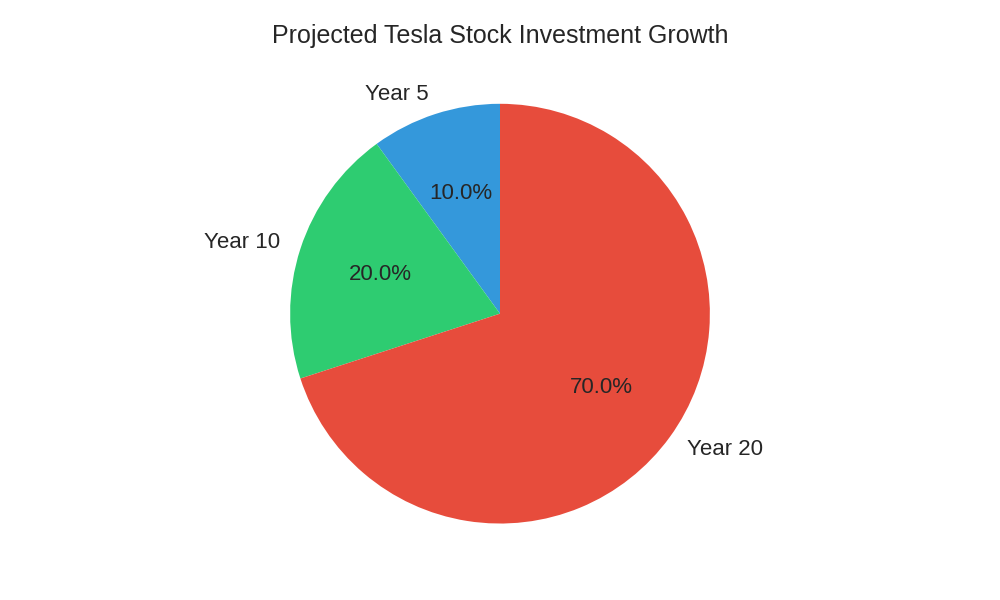
Let’s illustrate the power of compounding with a hypothetical investment in Tesla stock. This table shows how a consistent annual return might impact your investment over time, assuming you reinvest any gains.
| Investment Horizon | Initial Investment | Projected Value (Example Annual Return) |
|---|---|---|
| Year 5 | $10,000 | $18,000 – $22,000 |
| Year 10 | $10,000 | $35,000 – $45,000 |
| Year 20 | $10,000 | $120,000 – $160,000 |
Note: These are illustrative figures based on a hypothetical annual return range (e.g., 12-18%) and do not represent actual or guaranteed returns. Investing in stocks carries inherent risks.
Frequently Asked Questions (FAQ)
Q1: Is Tesla stock a good investment for beginners?
Tesla stock can be volatile, making it a higher-risk option for beginners. While it offers high growth potential, it also requires a strong understanding of market dynamics and a higher risk tolerance. Beginners might consider diversified ETFs that include Tesla as a component, reducing exposure to single-stock risk.
Q2: How much should I invest in Tesla stock?
There’s no single “right” amount. It depends entirely on your financial situation, investment goals, and risk tolerance. Financial advisors often recommend that individual stocks, especially volatile ones, represent only a portion of a well-diversified portfolio. Never invest more than you can comfortably afford to lose.
Q3: What are the main risks of investing in Tesla?
Key risks include intense competition in the EV market, potential regulatory hurdles, supply chain disruptions, reliance on key personnel (Elon Musk), and the inherent volatility of growth stocks. Future technological advancements from competitors could also impact Tesla’s market position.
Q4: Should I buy Tesla stock now or wait?
Deciding when to buy is challenging, even for seasoned investors. Instead of trying to “time the market,” consider a strategy like dollar-cost averaging. This involves investing a fixed amount regularly, regardless of the stock price, which can help average out your purchase price over time and reduce the impact of short-term volatility.
Conclusion
Investing in Tesla stock presents an exciting opportunity to align your portfolio with innovation and sustainable energy. However, like any investment, it requires a clear understanding of the company’s business, financial health, and the broader market dynamics.
By conducting thorough research, understanding the risks, and developing a disciplined strategy, you can make informed decisions. Remember, knowledge is your most powerful tool in the world of investing. Continue to educate yourself, diversify your portfolio, and consider consulting a financial advisor to tailor a strategy that fits your individual goals.
Disclaimer: The information provided in this article is for educational purposes only and does not constitute financial advice.