

You’re a growth-focused tech investor, always scanning the horizon for the next seismic shift. Right now, that shift is undeniably Artificial Intelligence. You’ve seen the headlines, the massive valuations, and perhaps felt that nagging fear of missing out on the biggest technological revolution since the internet. The challenge isn’t just knowing that AI is big; it’s navigating the bewildering landscape of companies, separating the genuine innovators from the hype, and making strategic decisions about investing into AI that yield exponential gains.
Forget generic advice. You need an insider’s perspective to confidently place your capital. This isn’t about chasing the latest meme stock with “AI” in its name. It’s about understanding the underlying currents, identifying true value, and mastering the art of investing into AI with conviction. Your goal is not just growth, but strategic growth, protecting your downside while maximizing your upside in this rapidly evolving sector.

Decoding the AI Investment Landscape: More Than Just Chips
The AI revolution isn’t a monolithic entity. It’s a complex ecosystem, and a common myth to avoid is thinking it’s all about one or two dominant chip manufacturers. While companies like NVIDIA are undoubtedly critical infrastructure providers, the real opportunity often lies in understanding the layers of the AI stack.
Insider Tip: Don’t just look at the ‘picks and shovels’ (hardware). Also, consider the ‘miners’ (data providers), the ‘toolmakers’ (software platforms and models), and the ‘gold prospectors’ (application builders leveraging AI to disrupt industries). A diversified approach to investing into AI means looking beyond the obvious.
Scenario: Imagine two companies. Company A manufactures cutting-edge AI accelerators, selling to everyone. Company B develops proprietary AI software that optimizes logistics for a niche, high-growth industry, boasting significant recurring revenue and high switching costs. While Company A might offer steady growth, Company B, with its deep vertical integration and specialized AI, could deliver truly disruptive returns once it captures market share. Understanding these nuances is crucial.
Why does this matter in real life? Because focusing solely on hardware limits your exposure to the vast potential across software, services, and niche applications. It’s about finding the companies that are not just using AI but are fundamentally powered by AI to create new value.
Strategic Pillars for AI Portfolio Growth
Building a robust AI investment portfolio requires a thoughtful strategy, balancing nascent innovation with established players. You’re not just buying a stock; you’re buying a piece of future innovation.
- Diversification Across the AI Stack: Allocate capital across hardware, software, platforms, and application layers. This mitigates the risk of any single segment underperforming. For example, if you’re heavily invested in generative AI models, also consider companies providing the cloud infrastructure these models run on.
- Long-Term Vision vs. Short-Term Hype: AI is a marathon, not a sprint. While some companies might see speculative short-term pumps, true wealth is built by identifying firms with sustainable competitive advantages and holding for the long haul. Look for companies solving fundamental problems with AI.
- Assessing Competitive Moats: Does the company have proprietary data, unique algorithms, strong intellectual property, or a dominant market position that makes it hard for competitors to replicate? These are the hallmarks of a sustainable AI leader.
Identifying True AI Innovators
Many companies claim to be “AI-driven.” Your job is to cut through the marketing jargon and identify those with genuine, defensible AI innovation. This requires deep due diligence.
Pro/Con Analysis: Large Caps vs. Disruptive Startups
| Category | Pros | Cons |
|---|---|---|
| Large-Cap Tech Giants | Stability, vast resources, established market share, often embed AI into existing profitable products. | Slower growth relative to startups, bureaucratic hurdles, innovation can be incremental. |
| Disruptive AI Startups | Potentially exponential growth, agile innovation, ability to redefine markets. | High failure rate, volatile valuations, unproven business models, intense competition. |
Real-life Example: Consider Microsoft’s integration of AI into Office 365 (Copilot). This is a strong, stable play leveraging an existing customer base. In contrast, a startup like OpenAI, while revolutionary, faced initial uncertainty around its business model and path to profitability before significant investment. Both represent valid AI plays, but with vastly different risk/reward profiles. Your portfolio might ideally include both for balance.
You need to assess not just what they do, but how their AI provides a superior, scalable, and defensible solution. Are they simply adopting AI tools, or are they truly building proprietary AI capabilities that solve a critical market need?

How to Calculate Your Potential AI Investment Returns
Understanding potential returns isn’t about crystal ball gazing; it’s about setting realistic expectations and appreciating the power of compound growth. When investing into AI, you’re often looking at companies with significant growth potential, but also inherent volatility.
Let’s consider a simplified scenario. Imagine you invest a sum, say, between $10,000 and $25,000, into a diversified basket of AI-focused companies. Over the long term, these investments could grow at an average annual rate, perhaps ranging from 15% to 25%, depending on market conditions and your specific portfolio choices. To project your potential returns, you’d consider your initial investment, the assumed annual growth rate, and the investment horizon.
For example, if you start with $20,000 and anticipate a conservative 18% annual return, after one year, you’d have your initial $20,000 plus 18% of that, totaling $23,600. The next year, you’d earn 18% on $23,600, not just your initial capital. This snowball effect is the magic of compounding.
You can approximate future value by simply taking your initial investment and multiplying it by (1 + annual growth rate) raised to the power of the number of years. This allows you to visualize the potential long-term impact of your current investment decisions. While specific numbers are impossible to guarantee, this exercise helps you grasp the scale of potential gains.
This matters in real life because it helps you quantify the potential impact of even small, consistent investments over time. It shifts focus from daily stock fluctuations to the larger trajectory of your wealth accumulation.
For more personalized projections and to experiment with different scenarios, consider using a financial calculator:
AI Investment Growth Forecaster
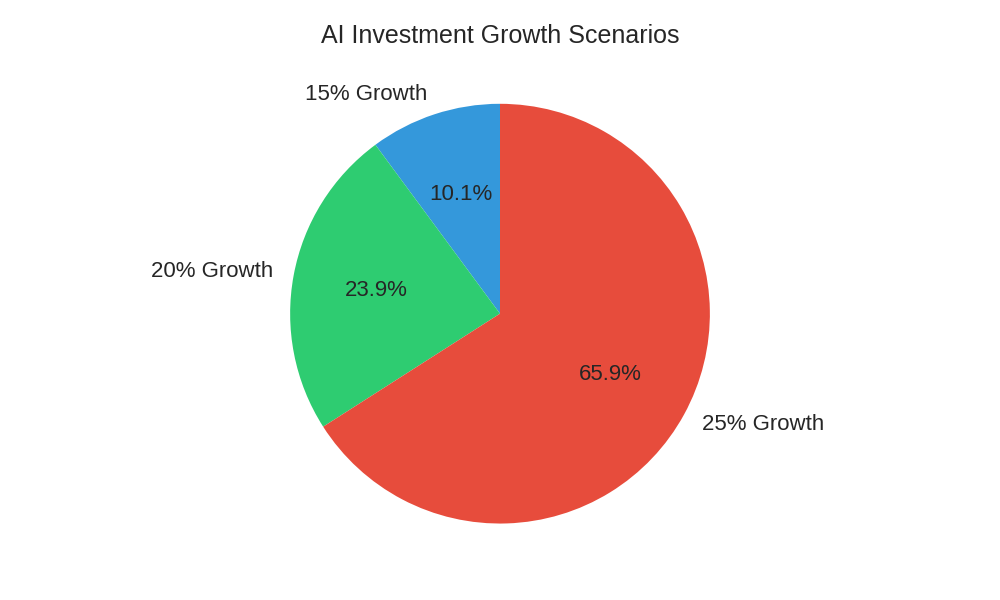
Here’s a simplified illustration of how different growth rates could impact an initial investment over time, showcasing the power of compound interest:
| Initial Investment | Annual Growth Rate | Estimated Value (Year 5) | Estimated Value (Year 10) | Estimated Value (Year 20) |
|---|---|---|---|---|
| $20,000 | 15% | ~$40,227 | ~$80,911 | ~$325,000 |
| $20,000 | 20% | ~$49,766 | ~$123,835 | ~$768,900 |
| $20,000 | 25% | ~$61,035 | ~$186,265 | ~$2,118,500 |
These are illustrative examples, of course. Actual returns vary wildly and involve significant risk.
Common Myths and Pitfalls in AI Investing
As a savvy investor, you know that where there’s opportunity, there’s also misinformation and speculative fervor. Avoiding these pitfalls is as critical as identifying winning investments.
- Myth: All AI Companies Will Succeed. False. The vast majority of startups fail. Even established companies can struggle to monetize their AI efforts. Differentiation and execution are paramount.
- Pitfall: Chasing the Hype Cycle. The AI sector is prone to intense hype. Don’t buy into a company solely because it’s been featured prominently or seen a sudden, inexplicable surge. Fundamental analysis still matters more than fleeting trends. You can read more about market dynamics and investing wisely at sites like Bloomberg.
- Myth: AI will instantly replace all human jobs. This oversimplification often leads to misguided investment decisions. AI is more likely to augment human capabilities, creating new industries and job categories. Focus on companies building these augmenting technologies.
- Pitfall: Ignoring Valuation. Even the best companies can be bad investments if you pay too much for them. Growth at any price is a dangerous strategy. Scrutinize valuations against growth prospects, profitability, and competitive landscape.
Due Diligence Beyond the Hype
Your investment decisions should be grounded in solid research. This means going beyond press releases and investor presentations. Look into SEC filings for a clearer picture of a company’s financials and risks. Resources like the U.S. Securities and Exchange Commission website are invaluable.
Insider Tip: Pay close attention to a company’s management team. Do they have a proven track record in AI or related fields? Do they have a clear strategy for monetizing their AI innovations? A strong, visionary leadership team is often a significant predictor of success in rapidly evolving tech sectors.
Furthermore, understand the regulatory environment. AI ethics, data privacy, and potential government oversight are growing concerns that could impact business models. Stay informed about the broader technological and policy shifts. For broad tech news and analysis, sites like TechCrunch can provide insights.

Conclusion: Seizing Your AI Advantage
Investing into AI isn’t just about riding a wave; it’s about skillfully navigating its currents. As a growth-focused tech investor, your unique advantage lies in your ability to understand technology and identify disruptive trends before the mainstream. By focusing on fundamental value, embracing strategic diversification, and exercising rigorous due diligence, you can position yourself for substantial long-term gains.
The AI revolution is here, and it’s accelerating. The choices you make now will define your portfolio’s performance for decades to come. Don’t just observe; participate strategically. Start with a clear strategy, commit to continuous learning, and don’t hesitate to consult with a qualified financial advisor to tailor your AI investment strategy to your specific financial goals and risk tolerance.
The time to act is now. Educate yourself, strategize, and confidently carve out your stake in the future of AI. Your exponential gains await.
Disclaimer: The information provided in this article is for educational purposes only and does not constitute financial advice.