

Are you ready to unlock a powerful path to building significant wealth and achieving true financial independence? The concept of business investing is not just for Wall Street moguls; it’s a strategic approach accessible to anyone willing to learn and commit. This comprehensive guide will demystify the world of business investing, offering clear, actionable steps to help you navigate your journey toward financial freedom.
In essence, business investing involves allocating capital into businesses with the expectation of generating a profit or increasing your wealth over time. This can range from buying shares in public companies to funding a promising startup or even launching your own venture. It’s a proactive way to make your money work harder for you, potentially far surpassing the returns of traditional savings accounts. By understanding and embracing business investing, you’re not just saving; you’re building a stake in economic growth.

What is Business Investing?
Business investing is the act of committing money or resources to a company or venture with the expectation of a financial return. This return can come from various sources, such as capital appreciation (the value of your investment going up), dividends (a share of the company’s profits), or interest payments (if you’ve lent money to a business). It’s about becoming a part-owner, a lender, or a direct builder of an enterprise.
Why does this matter in real life? Simply put, business investing is a primary driver of wealth creation. Instead of merely watching your savings potentially erode due to inflation, you can deploy your capital into productive assets that grow with the economy. For example, imagine you put money into a company that innovates in renewable energy. As that company expands and its technology gains traction, your investment grows in value, directly benefiting from its success. This is a much more dynamic path than simply keeping money in a low-interest bank account.
Types of Business Investing
The world of business investing offers diverse avenues, each with its unique risk and reward profile.
-
Public Equities (Stocks)
This is perhaps the most common form of business investing, involving buying shares of companies traded on stock exchanges. When you buy a stock, you own a tiny piece of that company.
Why it matters: Stocks offer high liquidity, meaning you can typically buy and sell them easily. They also provide diversification opportunities across different industries. Imagine buying shares in a well-established technology giant; your investment benefits from their global sales and innovation, making you a passive beneficiary of their broad market success.
-
Private Equity and Venture Capital
These involve investing in private companies not traded on public exchanges. Private equity often targets mature companies, while venture capital focuses on early-stage, high-growth startups.
Why it matters: This avenue offers potentially higher returns, as you’re getting in early on disruptive companies. For instance, if you had invested early in a now-famous social media platform when it was just a small startup, your initial capital could have multiplied exponentially as the company grew to dominate its market. It’s about identifying the next big thing before it becomes mainstream.
-
Debt Investing (Lending to Businesses)
In this approach, you provide loans to businesses and receive interest payments in return. This can be done through bonds, peer-to-peer lending platforms, or direct loans.
Why it matters: Debt investing typically offers a more predictable income stream compared to the fluctuating stock market. For example, lending money to a thriving local restaurant might provide you with steady monthly interest income, a reliable cash flow different from the capital gains sought in equity investments.
-
Franchising
Buying a franchise means investing in a proven business model under an established brand name. You operate the business, but benefit from brand recognition and corporate support.
Why it matters: Franchising reduces much of the startup risk associated with launching a new business from scratch. A common example is buying a popular coffee shop franchise; you immediately gain access to their brand, standardized operations, marketing materials, and supplier networks, providing a head start in a competitive market.
-
Starting Your Own Business
This is arguably the most direct form of business investing. You invest your time, money, and effort to build a new enterprise from the ground up.
Why it matters: It offers the highest level of control and the potential for the greatest rewards. If you successfully launch an online store selling unique handmade crafts, every sale and every customer directly contributes to the value of your initial investment and ongoing efforts, giving you direct control over your financial outcome.
The “How To” Guide: Steps to Successful Business Investing
Embarking on your business investing journey requires a structured approach. Here are the key steps:
- Educate Yourself Continuously: Before you invest a single dollar, commit to learning. Understand market dynamics, financial statements, and economic indicators. Read reputable financial news and books.
- Define Your Financial Goals: What do you want your investments to achieve? Are you saving for retirement, a down payment, or early financial independence? Your goals will dictate your investment strategy and time horizon.
- Assess Your Risk Tolerance: How comfortable are you with the potential for your investment value to fluctuate? Some investments are riskier but offer higher potential returns, while others are more stable but grow slower. Be honest about what you can stomach.
- Conduct Thorough Research (Due Diligence): This is perhaps the most critical step. For any potential investment, dig deep. Research the company’s management, its financial health (revenue, profit, debt), its industry, and its competitors.Scenario: Imagine you are considering investing in a small, privately held software company. You wouldn’t just look at their flashy website. You’d review their last three years of financial statements, talk to their management team, assess their customer acquisition strategy, and understand their competitive landscape to determine their true potential and risks.
- Diversify Your Portfolio: Never put all your capital into a single investment. Spread your investments across different companies, industries, and asset classes to mitigate risk.
- Start Small and Scale Up: You don’t need a fortune to begin. Start with an amount you’re comfortable losing, learn from your experiences, and gradually increase your investments as your knowledge and confidence grow.
- Monitor and Adjust Your Investments: The market is dynamic. Regularly review your portfolio’s performance against your goals and make adjustments as needed. This doesn’t mean constant trading, but rather periodic reevaluation.Mini Case Study: Sarah began her investment journey by allocating $5,000 into a broad market index fund. Over two years, she diligently learned about sector-specific growth. Encouraged by her initial returns and new insights, she then invested an additional $2,000 into a promising biotechnology startup via a regulated crowdfunding platform, carefully balancing the higher risk with her established, diversified base.

Calculating Potential Returns in Business Investing
Understanding how your money can grow is key to successful investing. While precise predictions are impossible, you can grasp the principles of potential returns.
-
Understanding Return on Investment (ROI)
Simply put, ROI measures the profitability of your investment relative to its cost. If you invest $1,000 in a business and it generates a profit of $150, your profit is $150. Your ROI is 15% ($150 / $1,000).
Why it matters: ROI helps you compare the efficiency of different investments. A higher ROI generally means a better use of your capital. It tells you directly how much bang you’re getting for your buck.
-
The Power of Compounding
Compounding is when your investment earnings themselves start to earn returns. It’s often called “interest on interest.”
Why it matters: Compounding is the single most powerful force in long-term wealth creation. Imagine you invest $10,000 and earn an average of 7% per year. In the first year, you earn $700, making your total $10,700. In the second year, you earn 7% on $10,700, which is $749. Over many years, these steadily increasing earnings dramatically accelerate your wealth accumulation, turning modest initial investments into significant sums. This effect is why starting early is so beneficial for investors.
Return on Investment (ROI) Calculator
Managing Risks in Business Investing
All investing involves risk, but understanding and managing these risks is crucial for long-term success.
-
Market Risk
This is the risk that the overall market or economy will decline, negatively impacting your investments regardless of the specific companies you hold.
Real-life example: During a severe economic recession, even fundamentally strong companies may see their stock prices fall significantly, causing a temporary decrease in the value of your diversified portfolio, even if those companies are performing well internally.
-
Business-Specific Risk (Idiosyncratic Risk)
This risk relates to factors unique to a particular company or industry, such as poor management decisions, new competition, or a product recall.
-
Liquidity Risk
Some investments, especially in private businesses, can be difficult to sell quickly without a significant price discount.
-
Inflation Risk
This is the risk that your investment returns won't keep pace with inflation, meaning your purchasing power could decrease over time.
Why it matters: If your investment portfolio grows by 3% annually but the cost of living (inflation) increases by 4%, your real wealth actually diminishes. Business investing aims to generate returns that outpace inflation, preserving and growing your purchasing power.
Mitigation Strategies:
To manage these risks, always prioritize diversification across different assets and industries, conduct thorough research, and maintain a long-term perspective. Avoid emotional decisions based on short-term market fluctuations.
Building Your Business Investing Portfolio
A well-constructed portfolio is diverse and aligned with your personal financial roadmap.
- Balance Growth and Stability: A robust portfolio often blends investments with high-growth potential (e.g., tech stocks, venture capital) with more stable, income-generating assets (e.g., dividend stocks, bonds).
- Align with Your Goals and Timeline: Your investment choices should reflect your specific financial objectives and the length of time you have to invest. A younger investor with decades until retirement might tolerate more risk for higher growth, while someone nearing retirement might prioritize capital preservation and income.Scenario: A young professional in their 20s with a 30-year investment horizon might allocate 70% of their portfolio to growth-oriented public stocks and perhaps 10% to a high-risk, high-reward startup through crowdfunding. In contrast, someone in their 50s aiming for retirement in 5-10 years might shift to 60% in stable dividend-paying stocks and bonds, with a smaller portion in lower-risk, established companies.
- Consider Professional Guidance: For complex situations or if you prefer expert oversight, consulting a qualified financial advisor can provide personalized strategies and help you navigate market complexities. For official information on investor protection and regulations, visit the U.S. Securities and Exchange Commission (SEC) website.

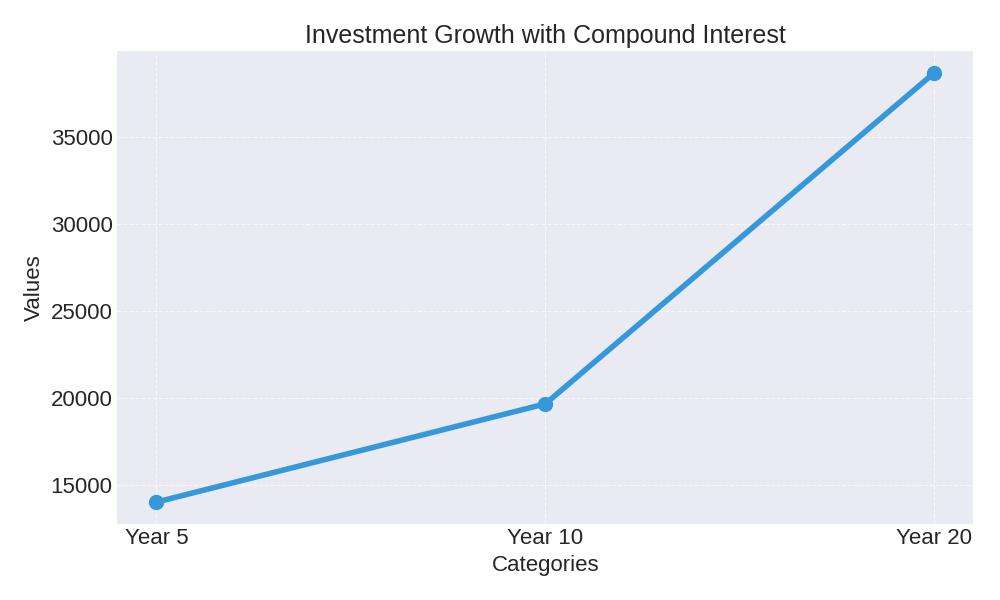
Compound Growth Scenario: The Long-Term Power of Investing
This table illustrates how a one-time initial investment can grow significantly over time, assuming an average annual return. This demonstrates the incredible power of compound interest, where your earnings begin to generate their own earnings.
| Investment Horizon | Initial Investment | Estimated Value (7% Annual Growth) |
|---|---|---|
| Year 5 | $10,000 | ~$14,025 |
| Year 10 | $10,000 | ~$19,670 |
| Year 20 | $10,000 | ~$38,697 |
Note: These are illustrative figures. Actual returns can vary based on market conditions and specific investments.
Frequently Asked Questions (FAQ)
- Q: How much money do I need to start business investing?
A: You can start with relatively small amounts. Many brokerage firms allow you to buy fractional shares of stocks for as little as $5. Crowdfunding platforms for private businesses can also have low entry points, sometimes starting at $100-$500. The key is to start consistently. For general business resources, visit USA.gov. - Q: Is business investing only for the wealthy?
A: Absolutely not. While high-net-worth individuals have access to exclusive private equity deals, the advent of public stock markets, ETFs, mutual funds, and crowdfunding has democratized access to business investing for almost everyone. - Q: What's the fundamental difference between investing in a business and just saving money?
A: Saving money typically means placing it in a secure account, like a bank savings account, where it earns minimal interest and focuses on capital preservation. Investing, especially in businesses, involves taking on a calculated risk to achieve potentially much higher returns that aim to outpace inflation and significantly grow your wealth. - Q: How long should I expect to hold an investment?
A: This depends on your goals and the type of investment. For significant wealth building through business investing, a long-term approach (often 5, 10, or even 20+ years) is generally recommended. This allows your investments time to recover from market downturns and benefit from the power of compounding. For more insights on long-term investment strategies, you can explore resources like Bloomberg.
Conclusion
Business investing is a dynamic and rewarding journey that, when approached with knowledge and discipline, can be your most effective strategy for building lasting financial freedom. It empowers you to participate in the growth of innovative companies and the broader economy, moving beyond simply saving to actively creating wealth.
Start by educating yourself, define your goals, understand your risk tolerance, and diversify your investments. The journey may have its ups and downs, but with a consistent, long-term approach, the rewards can be substantial. Begin exploring your options today, and if you feel overwhelmed, consider consulting a financial professional to help tailor a strategy that's right for you.
Disclaimer: The information provided in this article is for educational purposes only and does not constitute financial advice.