
Navigating the world of car insurance in Florida can feel like a complex journey, but with the right knowledge, you can drive smarter and save significantly. Florida, known for its sunshine and unique regulations, requires a specific approach to securing the best auto coverage. This guide is designed to be your most comprehensive and actionable resource, explaining intricate details in simple terms so you can make informed decisions. Whether you’re a long-time resident or new to the state, understanding the nuances of car insurance and Florida regulations is key to protecting your finances and ensuring peace of mind on the road. We’ll show you the smart way to save on your car insurance in Florida, ensuring you get adequate protection without overpaying.

Understanding Florida’s Unique Insurance Landscape
Florida operates under a “No-Fault” insurance system. This means that after an accident, your own insurance company typically pays for certain damages, regardless of who was at fault. This system is crucial for expediting claims and reducing litigation, but it also mandates specific coverage types for all drivers.
Why does this matter in real life? Imagine you’re involved in a minor fender-bender. Under Florida’s no-fault system, your insurance’s Personal Injury Protection (PIP) would cover your medical expenses and lost wages up to your policy limit, regardless of whether you caused the accident or not. This helps you get immediate care without waiting to determine fault.
Minimum Coverage Requirements in Florida
Florida law mandates two primary types of coverage for all registered vehicles:
- Personal Injury Protection (PIP): This covers 80% of your medical expenses, 60% of lost wages, and 100% of replacement services (like hiring someone to do household chores you can’t do) up to $10,000, regardless of who caused the accident. This is the cornerstone of Florida’s no-fault system.
- Property Damage Liability (PDL): This covers damage you might cause to another person’s property, such as their vehicle, fences, or mailboxes. The minimum required coverage is $10,000.
It’s important to note that unlike most states, Florida does not require Bodily Injury Liability (BIL) as part of its minimums, though it is highly recommended. For more details on these requirements, you can always refer to the official Florida Office of Insurance Regulation.
Beyond the Basics: Essential Coverage Options
While Florida’s minimums provide a basic safety net, they often aren’t enough to fully protect you financially. Smart drivers in Florida opt for additional coverage to safeguard against larger, more costly incidents.
Bodily Injury Liability (BIL)
This coverage pays for medical expenses, lost wages, and pain and suffering for others if you are at fault in an accident. Florida doesn’t mandate it, but it’s critically important. Why does this matter in real life? Imagine you cause an accident where another driver suffers severe injuries, leading to medical bills exceeding $50,000. Without BIL, you would be personally responsible for these costs, potentially leading to financial ruin or asset forfeiture. Opting for at least $25,000/$50,000 (per person/per accident) is a common recommendation to protect your assets.
Collision Coverage
This pays for damage to your own vehicle resulting from a collision with another car or object, regardless of who is at fault. Why does this matter? If you accidentally hit a tree or another car, collision coverage ensures your vehicle is repaired or replaced, minus your deductible. Without it, you’d pay out of pocket for all repairs.
Comprehensive Coverage
Often paired with collision, comprehensive coverage protects your vehicle from non-collision incidents. This includes theft, vandalism, fire, natural disasters (like hurricanes or floods, which are common in Florida), and impacts with animals. Why does this matter? A severe Florida hurricane could easily flood your car. Comprehensive coverage would cover these damages, saving you potentially tens of thousands of dollars.
Uninsured/Underinsured Motorist (UM/UIM)
This coverage protects you if you’re hit by a driver who either has no insurance or insufficient insurance to cover your damages. Why does this matter? In Florida, where many drivers only carry minimum PIP/PDL, UM/UIM can be a lifesaver. If an uninsured driver totals your car and leaves you with $30,000 in medical bills, your UM/UIM policy would step in to cover those costs, preventing you from shouldering the burden yourself.

The Smart Way to Save: Actionable Strategies
Saving money on your car insurance in Florida doesn’t mean sacrificing essential protection. It’s about being strategic and proactive.
How to Calculate Your Potential Savings
Calculating potential savings involves understanding the factors that influence your premiums and actively seeking out better deals. Insurance companies assess various risk factors: your driving record, age, vehicle type, location, credit score, and even your marital status. Each factor contributes to your overall premium.
To estimate savings, start by gathering quotes from multiple providers. For example, if your current premium is $1,800 annually, and a new provider offers similar coverage for $1,400 after applying discounts, your potential annual saving is $400. You can also estimate savings by identifying specific discounts you qualify for. If a good driver discount saves you 15% on a $1,500 premium, that’s $225 back in your pocket. Think of it as directly reducing the cost based on your risk profile and chosen benefits. Regularly comparing your current premium against new quotes, especially when your policy is up for renewal, is the most direct way to identify savings opportunities.
Here’s a simple way to think about it:
- Identify Your Current Cost: What are you paying now for your current coverage?
- Explore Discount Eligibility: Which discounts do you qualify for but might not be using?
- Shop Around: Get at least 3-5 quotes from different insurers for comparable coverage.
- Compare and Save: The difference between your highest and lowest comparable quote, plus any new discounts, represents your potential savings.
Car Insurance Florida: The Smart Way to Save
Leveraging Discounts
Insurance companies offer numerous discounts that can significantly reduce your premiums. Always ask your insurer about these.
- Multi-Policy Discount: Bundling your auto and home insurance can lead to substantial savings, often 10-20% on each policy.
- Good Driver Discount: Maintaining a clean driving record (no accidents or tickets for 3-5 years) can earn you a discount.
- Defensive Driving Course: Completing an approved defensive driving course can reduce your rates, especially for younger or older drivers.
- Anti-Theft Devices: Vehicles equipped with alarms or tracking systems often qualify for discounts.
- Good Student Discount: If you or a driver on your policy is a full-time student with a B average or better, you might be eligible.
- Low Mileage Discount: If you drive less than a certain number of miles annually, you could save.
Why this matters: Imagine you combine multiple discounts – a multi-policy discount saving 15%, a good driver discount saving 10%, and a defensive driving discount saving 5%. On a $2,000 annual premium, these could collectively save you over $600 each year! This is a powerful way to make your car insurance and Florida expenses more manageable.
Adjusting Deductibles
A deductible is the amount you pay out-of-pocket before your insurance coverage kicks in after a claim. Choosing a higher deductible typically lowers your premium. Why does this matter? If you increase your deductible from $500 to $1,000, your annual premium could decrease by $100-$300. This is a good strategy if you have a robust emergency fund and are comfortable covering a larger initial cost in case of an accident. However, ensure your deductible is an amount you can comfortably afford in an emergency.
Reviewing Your Policy Annually
Life changes can impact your insurance needs and rates. Review your policy at least once a year or whenever a major life event occurs. Why does this matter? If you get married, move to a new zip code, buy a new car, or your driving habits change (e.g., working from home more), your current policy might no longer be the most cost-effective or appropriate. A quick review can uncover new discounts or highlight areas where you might be over-insured or under-insured. You can explore general insurance information and resources from the Insurance Information Institute to better understand common policy adjustments.
Improving Your Driving Record
Your driving record is one of the biggest factors influencing your premium. Accidents, traffic violations, and DUIs significantly increase your rates. Why does this matter? A single speeding ticket could raise your premium by 10-20% for several years. Conversely, maintaining a clean record directly translates to lower rates and access to better discounts. Focus on safe driving habits to keep your premiums down.
Comparative Analysis: Understanding Policy Value
To truly save, it’s not just about the lowest premium; it’s about the best value for your specific needs. Here’s how different coverage choices can impact your protection and costs over time:
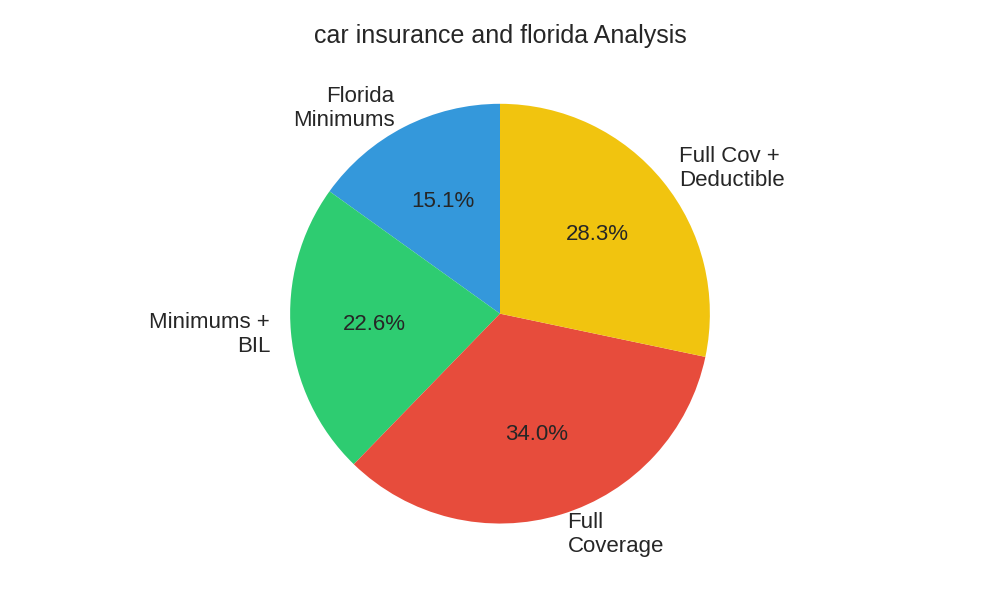
| Coverage Scenario | Annual Premium Range (Estimate) | Out-of-Pocket Risk (Example) | Key Benefit |
|---|---|---|---|
| Florida Minimums (PIP $10k, PDL $10k) | $800 – $1,500 | High (e.g., $50,000+ for serious injuries, own vehicle damage) | Meets legal requirements, lowest upfront cost |
| Minimums + BIL ($25k/$50k) | $1,200 – $2,200 | Moderate (e.g., own vehicle damage, hit by uninsured driver) | Protects your assets from injuring others |
| Full Coverage (BIL, Collision, Comp, UM/UIM) | $1,800 – $3,500+ | Low (deductibles) | Comprehensive financial protection for you, your car, and others |
| Full Coverage + High Deductibles | $1,500 – $3,000 | Slightly higher (larger deductible amount) | Lower premiums with strong coverage, ideal if you have emergency savings |
This table illustrates how increasing your coverage beyond the absolute minimum, even with a slightly higher premium, can drastically reduce your financial risk. For instance, choosing full coverage might cost more annually, but it protects you from potentially crippling out-of-pocket expenses that could arise from a severe accident or natural disaster. You can often find independent reviews of insurance providers to help you choose the best fit for your needs at sites like Consumer Reports.

Frequently Asked Questions (FAQ)
Q: Why is car insurance in Florida often considered expensive?
A: Florida’s high population density, frequent severe weather (hurricanes, floods), a higher rate of uninsured drivers, and a prevalence of insurance fraud contribute to generally higher premiums compared to other states. The no-fault system, while beneficial in some ways, also adds to the cost structure.
Q: Does my credit score affect my car insurance rates in Florida?
A: Yes, in Florida, insurers can use a credit-based insurance score as one factor in determining your premium. Generally, a higher credit score can lead to lower rates, as it’s often seen as an indicator of financial responsibility.
Q: Can I drive without Bodily Injury Liability (BIL) in Florida?
A: Legally, yes, you can drive without BIL as it’s not part of Florida’s minimum requirements. However, it is strongly advised against. Without BIL, if you cause an accident resulting in injuries to others, you are personally responsible for their medical bills and other damages, potentially leading to lawsuits and significant financial burdens.
Q: What’s the best way to get cheap car insurance in Florida?
A: The “cheapest” isn’t always the “best” if it means inadequate coverage. The smart way to save is to:
- Shop around and compare quotes from multiple insurers.
- Utilize all applicable discounts.
- Choose a deductible you can comfortably afford.
- Maintain a clean driving record.
- Review your policy regularly.
Focus on getting adequate coverage at the most competitive price, rather than just the lowest price.
Q: What happens if I have an accident with an uninsured driver in Florida?
A: If you have PIP, it will cover your medical expenses up to your limit. However, for damages to your vehicle or additional medical costs beyond PIP, you would need collision coverage for your car and Uninsured Motorist (UM) coverage for your injuries. Without these, you would likely bear the costs yourself or have to sue the uninsured driver, which can be a long and difficult process.
Conclusion
Navigating car insurance in Florida requires understanding the state’s unique no-fault system, knowing your essential coverage options, and proactively seeking ways to save. By applying these strategies – from leveraging discounts to regularly reviewing your policy – you can secure comprehensive protection without breaking the bank. Remember, the goal isn’t just to find cheap car insurance in Florida, but to find the right coverage that offers you the best financial security and peace of mind on the road.
Call to Action: Don’t wait for your policy renewal notice. Take action today! Get several competitive quotes, review your current coverage, and explore the discounts available to you. Your wallet and your peace of mind will thank you.
Disclaimer: The information provided in this article is for educational purposes only and does not constitute financial advice.