
Navigating the world of investments can feel like deciphering a secret language. Two terms you’ll frequently encounter are index investing vs mutual funds. For many investors, especially those focused on long-term wealth growth, understanding the differences is crucial to unlocking their best returns.
In short, while an index fund is technically a type of mutual fund, the common distinction refers to actively managed mutual funds versus passively managed index funds (or ETFs). The direct answer for most looking for broad market exposure and lower costs is that index investing often provides a more straightforward, efficient, and ultimately more profitable path due to its simplicity and significantly lower fees.
This guide will cut through the jargon, providing a comprehensive and actionable roadmap to help you understand these investment vehicles and choose the best fit for your financial journey.

What is Index Investing?
Imagine you want to invest in the entire U.S. stock market, not just a few companies. That’s precisely what index investing aims to do. An index fund is a type of investment fund that buys and holds stocks or bonds in the same proportion as a specific market index. A popular example is an S&P 500 index fund, which holds stocks of the 500 largest U.S. companies, mirroring the performance of the S&P 500 index.
This approach is called passive management. Instead of fund managers actively picking stocks they believe will outperform, index funds simply track a predetermined benchmark. This method drastically reduces research and trading costs.
Why Index Investing Matters in Real Life
The beauty of index investing lies in its simplicity and efficiency. For example, if you invest in a total stock market index fund, you instantly own a tiny piece of hundreds or thousands of companies. This provides immense diversification, meaning your eggs aren’t all in one basket. If one company struggles, its impact on your overall portfolio is minimal.
Crucially, lower costs mean more of your money stays invested and grows. Over decades, even small differences in fees can lead to significantly different portfolio values. This is why many financial experts advocate for index funds as a core part of a long-term investment strategy. You essentially capture the market’s return without trying to beat it, which is harder than it sounds.
Decoding Mutual Funds
A mutual fund is a company that pools money from many investors and invests it in a diversified portfolio of securities like stocks, bonds, and other assets. When people typically refer to “mutual funds” in contrast to index funds, they usually mean actively managed mutual funds. These funds employ professional fund managers who actively research, buy, and sell securities with the goal of outperforming a specific market benchmark.
The managers might focus on particular sectors, growth companies, value stocks, or international markets, trying to identify mispriced assets. They aim to use their expertise to generate returns higher than what a simple market index would provide.
Why Actively Managed Mutual Funds Matter in Real Life
The promise of an actively managed mutual fund is the potential for superior returns. Imagine a fund manager with an incredible track record, consistently picking winning stocks in an emerging tech sector. Investors might be drawn to such a fund, hoping to capitalize on that expertise and beat the market averages.
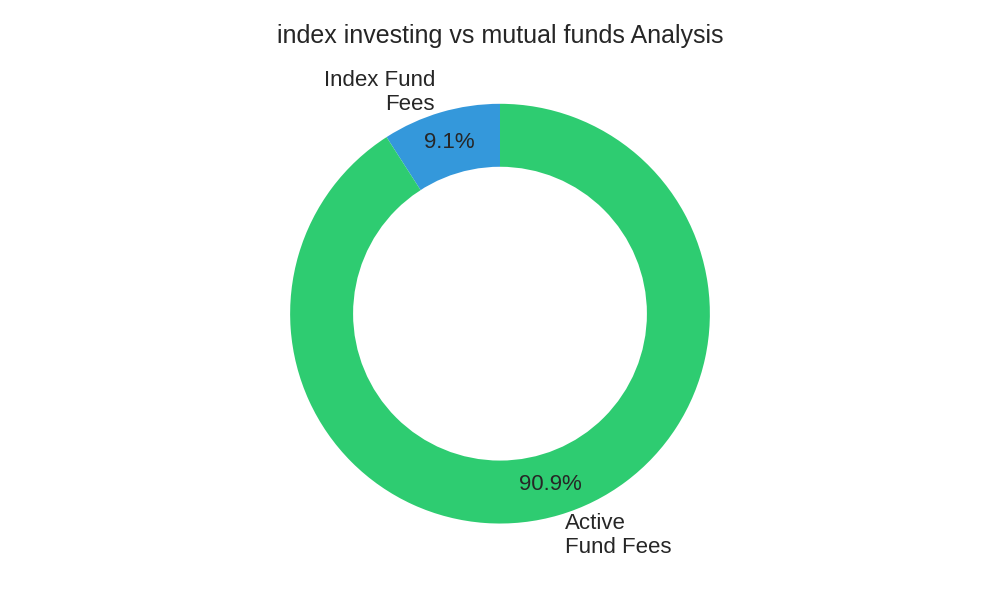
However, this active management comes at a cost. These funds typically have higher fees (known as expense ratios) to cover the salaries of the management team, research, and trading costs. While some actively managed funds do outperform their benchmarks in certain periods, consistently doing so over the long term is very challenging. Many studies show that a majority of actively managed funds fail to beat their benchmark index after accounting for fees.

Index Investing vs Mutual Funds: A Clear Comparison
When comparing index investing vs mutual funds, particularly actively managed ones, several key distinctions emerge. These differences directly impact your potential returns and overall investment experience. Understanding them is fundamental to making informed decisions.
| Feature | Index Funds (Passive) | Actively Managed Mutual Funds |
|---|---|---|
| Management Style | Tracks a market index (e.g., S&P 500) without active stock picking. | Professional managers actively pick stocks/bonds to beat a benchmark. |
| Expense Ratios (Fees) | Generally very low (e.g., 0.03% – 0.20% annually). | Typically higher (e.g., 0.50% – 2.00% annually). |
| Diversification | Broadly diversified, mirroring the entire market segment. | Can be diversified, but often more concentrated based on manager’s strategy. |
| Performance Goal | Match the performance of the underlying index. | Outperform the underlying index or benchmark. |
| Tax Efficiency | Often more tax-efficient due to lower turnover (fewer trades). | Less tax-efficient due to higher turnover (more frequent trading). |
| Manager Risk | Very low, as there’s no single manager’s skill to rely on. | Significant, as performance depends heavily on the manager’s skill. |
Why This Comparison Matters in Real Life
The differences outlined in the table directly translate into how much money you keep. Consider the impact of fees: A difference of just 1% in annual expense ratios might seem small, but over 30 years, it can reduce your final portfolio value by tens of thousands, or even hundreds of thousands of dollars, due to the power of compounding. For clear guidance on understanding investment costs, you can consult resources like the U.S. Securities and Exchange Commission (SEC) website.
An actively managed fund has to not only beat its benchmark but also cover its higher fees to truly benefit investors more than a low-cost index fund. This is a tall order for even the most skilled managers over the long run.
How to Calculate Your Potential Investment Growth (Simplified)
Understanding potential growth doesn’t require complex math. The core concept is compound interest, where your earnings also start earning money. This is often called “earning interest on interest.”
Imagine you invest $10,000. If it grows by an average of 7% per year, in the first year, you’d earn $700. Now you have $10,700. In the second year, you earn 7% on that new, larger amount, which is $749. Your money grows faster each year because the base amount is increasing. The longer your money is invested, the more powerful compounding becomes.
To estimate your future wealth, you’d typically consider your initial investment, any regular contributions, the expected annual return (minus fees!), and the number of years you plan to invest. Online calculators can do the heavy lifting for you.
Index vs. Actively Managed Fund Comparison
For example, if you start with $5,000 and contribute $200 per month for 20 years, assuming a modest 6% average annual return after fees, you could accumulate approximately $93,000 to $95,000. The key takeaway is that consistent investing, even small amounts, combined with reasonable returns and low fees, builds substantial wealth over time.
Choosing Your Investment Path
The choice between index investing and actively managed mutual funds depends on your personal financial goals, risk tolerance, and investment philosophy.
- When to lean towards Index Investing:
- Cost Sensitivity: If minimizing fees is a priority (which it generally should be for most investors).
- Broad Market Exposure: You want to invest in a wide range of companies and sectors, ensuring broad diversification.
- Long-Term Growth: Your investment horizon is long (e.g., retirement planning), allowing compounding and market averages to work.
- Simplicity: You prefer a “set it and forget it” approach without needing to constantly monitor fund manager performance.
- Consistent Returns: You’re content with matching market returns, rather than trying (and often failing) to beat them.
A young investor saving for retirement (30+ years away) would likely benefit immensely from the low-cost, diversified nature of index funds, letting compounding work its magic without high fee drag.
- When to consider Actively Managed Mutual Funds:
- Belief in Manager Skill: You have strong conviction in a specific fund manager’s ability to consistently outperform their benchmark.
- Specialized Markets: For highly niche or inefficient markets where active research might add significant value (though this is rare and difficult to predict).
- Specific Investment Goals: You need a fund tailored to very specific ethical, social, or governance (ESG) criteria not easily replicated by a broad index.
- Willingness to Pay for Potential Alpha: You are comfortable with higher fees and the risk of underperformance in exchange for the chance of superior returns.
An investor looking for exposure to a very specific, thinly traded global market might find an actively managed fund beneficial if that fund’s expertise provides access and research that’s otherwise unavailable.
For further education on investment products and strategies, reputable sources like Investopedia offer detailed explanations.

Frequently Asked Questions (FAQ)
-
Are index funds truly “safer” than actively managed mutual funds?
Neither is “safe” from market fluctuations. All investments carry risk. However, index funds are generally considered less risky in terms of individual stock picking because of their inherent diversification across many companies. Actively managed funds carry additional “manager risk”—the risk that the fund manager makes poor investment decisions.
-
Can I lose money with index investing?
Yes. If the overall market (the index you are tracking) declines, your index fund will also decline in value. Index investing is designed to capture market returns, whether up or down. It’s not a guarantee against losses, but it diversifies you against the risk of a single company performing poorly.
-
What about actively managed funds that do outperform?
Such funds exist, but consistently identifying them in advance is incredibly challenging. Past performance is no guarantee of future results. Many funds that perform well in one period may underperform in the next. The fees they charge often eat into any potential outperformance.
-
Are ETFs different from index funds?
An Exchange Traded Fund (ETF) is a type of fund that trades on stock exchanges, similar to individual stocks. Many ETFs are, in fact, index funds, meaning they track an index. The main difference is their trading mechanism: ETFs can be bought and sold throughout the day, while traditional mutual funds are priced once a day after the market closes. Many index funds are available as both mutual funds and ETFs.
-
What’s an “expense ratio”?
The expense ratio is the annual fee charged by a fund for management and operational costs. It’s expressed as a percentage of your total investment in the fund. For instance, a 0.50% expense ratio means you pay $5 annually for every $1,000 invested. Lower expense ratios mean more of your money stays invested and grows for you.
Conclusion
When weighing index investing vs mutual funds, especially actively managed ones, the evidence consistently points towards the advantages of low-cost, diversified index investing for the vast majority of long-term investors. Its combination of broad market exposure, minimal fees, and historical outperformance against most actively managed funds makes it a powerful tool for wealth accumulation.
Your investment journey is unique. While index funds offer a compelling path, it’s essential to align your choices with your personal financial goals and risk tolerance. Take the time to research, understand the implications of fees, and consider consulting with a qualified financial advisor to tailor a strategy that best suits your future. For advice on finding a financial professional, resources like FINRA’s investor education site can be invaluable.
Disclaimer: The information provided in this article is for educational purposes only and does not constitute financial advice.