

Are you tired of chasing volatile stocks or wrestling with the illiquidity and management headaches of direct property ownership? Many investors feel stuck between these extremes, missing out on the stability and income potential of real estate without the direct landlord burden. You’re looking for a smarter way to gain exposure to real estate, and you’re right to explore investing in real estate investment trusts (REITs). It’s a powerful strategy, but only if you navigate it correctly.
Why Investing in Real Estate Investment Trusts Deserves Your Attention
You already know real estate is a foundational asset class. But directly buying and managing properties requires significant capital, expertise, and time. This is where REITs shine, offering a publicly traded, highly liquid avenue to a diversified portfolio of income-producing properties. Think of them as mutual funds for real estate, allowing you to own a piece of commercial properties, apartments, data centers, or medical facilities, all managed by professionals.
The Core Advantages & Disadvantages
Before diving deep, it’s crucial to understand the dual nature of these investments. While immensely beneficial, REITs also come with their own set of challenges you must be prepared for.
- Liquidity: Unlike physical properties, REITs trade on major stock exchanges. You can buy or sell shares with ease, offering far greater flexibility than traditional real estate.
- Diversification: REITs can hold a variety of properties across different sectors and geographies, reducing your reliance on any single property’s performance. This provides valuable diversification beyond traditional stocks and bonds.
- Income Potential: By law, REITs must distribute at least 90% of their taxable income to shareholders annually in the form of dividends. This often translates to attractive yields, making them popular for income-focused investors.
- Professional Management: Experienced management teams handle property acquisition, development, and operations. You benefit from their expertise without lifting a finger.
However, no investment is without its downsides. You need to consider:
- Interest Rate Sensitivity: REITs can be sensitive to interest rate changes. Rising rates can make their borrowing costs higher and make their dividend yields less attractive compared to fixed-income alternatives.
- Market Volatility: As publicly traded securities, REITs are subject to stock market fluctuations. Economic downturns or specific sector challenges can impact their share price.
- Dividend Taxation: While attractive, REIT dividends are often taxed as ordinary income, not qualified dividends, which can mean a higher tax bill for some investors. Always consult a tax professional.
Key Strategies for Maximizing Returns
To truly maximize your returns when investing in real estate investment trusts, you need a disciplined approach that goes beyond simply buying the first REIT you find. Strategic selection and ongoing monitoring are paramount.
Sector Specialization and Diversification
Not all REITs are created equal. They specialize in various property types, and understanding these sectors is key to smart investing. You might consider:
- Residential REITs: Apartment buildings, single-family rentals.
- Retail REITs: Shopping malls, strip centers.
- Office REITs: Commercial office buildings.
- Industrial REITs: Warehouses, distribution centers.
- Healthcare REITs: Hospitals, medical office buildings, senior living facilities.
- Data Center REITs: Facilities that store critical IT infrastructure.
- Self-Storage REITs: Storage units for personal and business use.
A smart strategy often involves diversifying across several sectors to hedge against downturns in any single area. For instance, while office REITs might struggle in a work-from-home environment, industrial or data center REITs could thrive.
Insider Tips for Smart REIT Investing
Beyond the basics, successful REIT investing hinges on knowing what to look for that others often miss. Don’t just chase the highest dividend yield; delve deeper into the fundamentals.
- Focus on FFO (Funds From Operations): This is the true measure of a REIT’s profitability, not just net income. FFO adds depreciation and amortization back to net income, giving you a clearer picture of cash flow. A REIT with growing FFO per share is typically a healthy one.
- Evaluate Debt Levels: REITs often use leverage, but excessive debt can be risky. Look for REITs with manageable debt-to-FFO ratios and strong credit ratings. High leverage can amplify returns in good times but devastate them in bad.
- Management Quality: A seasoned, transparent, and shareholder-friendly management team is crucial. Research their track record, compensation structures, and strategic vision. Are they making smart capital allocation decisions?
- Property Location and Quality: Just like direct real estate, location matters. High-quality properties in desirable markets tend to perform better over the long term and maintain higher occupancy rates.
Common Myths to Avoid
Don’t fall for these misconceptions that can derail your REIT investment journey:
- Myth: All REITs are the same. Fact: As discussed, REITs specialize in vastly different property types, each with its own economic drivers and risks. A mall REIT is fundamentally different from a data center REIT.
- Myth: High dividend yield equals a good investment. Fact: A sky-high dividend yield can be a red flag, potentially indicating a struggling company whose stock price has fallen, making the yield artificially high. Always check if the dividend is sustainable based on FFO.
- Myth: REITs are immune to market downturns. Fact: While often less volatile than individual stocks, REITs are still publicly traded and can suffer significant drops during broader market corrections or economic recessions.
Understanding REIT Performance & Valuation
To truly understand how well your REIT investment is doing, you need to look beyond just the stock price. Key metrics provide a clearer picture of financial health and potential for future growth.
How to Estimate Your Potential Return (The Basics)
Calculating the exact future return on any investment is impossible, but you can estimate potential income and growth. For REITs, a simple way to approach this involves understanding two core components: dividend yield and FFO growth.
Let’s say you invest in a REIT. You’ll primarily benefit from the regular dividends it pays. To estimate your annual dividend income, you would take the REIT’s current annual dividend per share and multiply it by the number of shares you own. For example, if a REIT pays $2.00 per share annually and you own 100 shares, you’d expect to receive $200 in dividends that year.
Additionally, you’re looking for the REIT to grow its FFO over time. Growth in FFO often leads to increased dividends and, ideally, an appreciation in the REIT’s share price. If a REIT consistently grows its FFO by 5% per year, you might expect your total return (dividends plus capital appreciation) to be in a similar ballpark, assuming its valuation remains stable. This simple outlook gives you a foundational understanding of the income and growth drivers.
REIT Total Return Estimator
Long-Term Growth Scenarios for Investing in Real Estate Investment Trusts
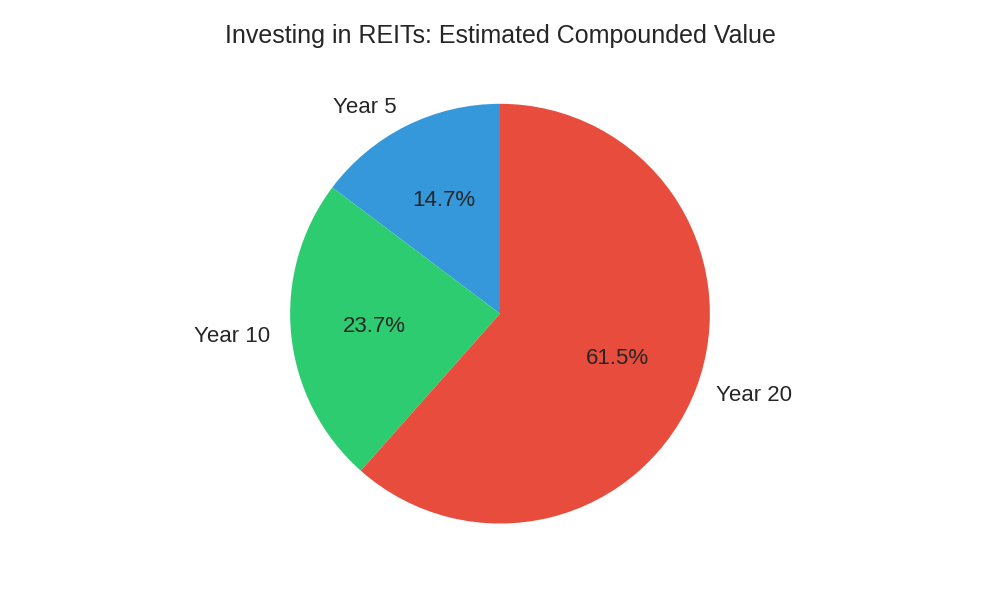
Compounding is your most powerful ally in long-term investing. Let’s look at how a consistent annual return can significantly grow an initial investment over time. This illustrates the power of letting your money work for you, a critical aspect of investing in real estate investment trusts for retirement or other long-term goals. While historical performance is no guarantee of future returns, understanding compounding helps frame expectations.
| Investment Period | Initial Investment ($) | Estimated Value (10% Annual Growth) ($) |
|---|---|---|
| Year 5 | 10,000 | 16,105 |
| Year 10 | 10,000 | 25,937 |
| Year 20 | 10,000 | 67,275 |
*This table is for illustrative purposes only, assuming a hypothetical 10% annual compounded return (including dividends and capital appreciation) and does not account for taxes or fees. Actual returns will vary significantly.
For further detailed information on REIT structure and regulations, you can explore resources from the U.S. Securities and Exchange Commission, which provides valuable insights into publicly traded investment vehicles. Additionally, understanding broader market trends for commercial real estate can be gained from reputable sources like Bloomberg. For specific REIT characteristics and financial health, Investopedia offers a wealth of definitions and guides.
Conclusion
Investing in real estate investment trusts can be a phenomenal strategy to diversify your portfolio, generate substantial income, and gain exposure to the real estate market without the operational burden. However, success isn’t handed to you. It demands diligent research, an understanding of FFO, careful evaluation of management, and a keen eye on property fundamentals and sector trends. Don’t be swayed by high yields alone; focus on sustainable growth and strong underlying assets.
Ready to take control of your financial future? Start researching specific REITs today, compare their FFO, debt levels, and sector exposure. Remember, your investment journey is unique. Consider consulting with a qualified financial advisor to ensure REITs align with your personal financial goals and risk tolerance.
Disclaimer: The information provided in this article is for educational purposes only and does not constitute financial advice.