

Navigating the world of personal finance can feel overwhelming, but securing your financial future doesn’t have to be a daunting task. A reliable investing service acts as your trusted partner, guiding you through market complexities and helping you build wealth over time. This comprehensive guide will simplify the process, empowering you to make informed decisions and confidently pursue your financial goals.
At its core, an investing service provides professional expertise and tools to help individuals and institutions grow their capital. These services typically involve assessing your financial situation, understanding your risk tolerance, and creating a personalized investment portfolio. Whether you’re saving for retirement, a down payment on a home, or simply looking to increase your net worth, a good investing service can offer strategic advice and management to help you achieve those aspirations.

Understanding Your Investing Journey
Before diving into specific services, it’s crucial to understand the foundational elements of investing. Your journey begins with defining your financial goals, assessing your comfort level with risk, and understanding the concept of diversification.
Define Your Financial Goals
What are you saving for? Clear goals provide direction. Common financial goals include:
- Retirement Planning: Building a nest egg for your golden years.
- Down Payment: Saving for a house or other significant purchase.
- Education Funding: Preparing for tuition costs.
- Wealth Accumulation: Growing your assets beyond specific short-term needs.
Each goal might require a different investment strategy and timeline. For long-term goals like retirement, you might consider a more aggressive approach, while short-term goals may call for more conservative investments.
Assessing Your Risk Tolerance
Risk tolerance is your psychological and financial capacity to take on investment risk. It’s about how much potential loss you can withstand in pursuit of higher returns. Generally, younger investors with longer time horizons can afford to take on more risk, as they have more time to recover from market downturns. Older investors approaching retirement often prefer lower-risk, capital-preserving strategies. It’s a critical factor in determining your ideal asset allocation.
The Power of Diversification
Diversification is the strategy of spreading your investments across various assets, industries, and geographies to minimize risk. The adage “don’t put all your eggs in one basket” perfectly encapsulates this principle. By diversifying, if one investment performs poorly, it won’t derail your entire portfolio. This strategy helps smooth out returns and protects your capital.
Types of Investing Services
The market offers a wide spectrum of investing services, each catering to different needs and preferences. Understanding the distinctions will help you choose the best fit for your financial situation.
Traditional Financial Advisors
These professionals offer personalized advice, comprehensive financial planning, and discretionary management of your portfolio. They often work on a fee-only or fee-based structure, providing a high level of individualized attention. Traditional advisors are ideal for those who prefer hands-on guidance and complex financial planning needs.
Robo-Advisors
Robo-advisors are automated, algorithm-driven platforms that provide investment management with minimal human intervention. They are typically lower cost, require lower minimum investments, and are excellent for investors seeking a streamlined, cost-effective solution. They build and manage diversified portfolios based on your goals and risk tolerance.
Brokerage Firms
Brokerage firms allow you to buy and sell various investment products, such as stocks, bonds, mutual funds, and Exchange-Traded Funds (ETFs). Full-service brokerages may offer research and advice, while discount brokerages provide tools for self-directed investors. These are suitable for investors who want to manage their own portfolios but need access to market instruments.
Online Investment Platforms
Similar to discount brokerages, online platforms often provide a user-friendly interface for self-directed investing. Many also offer educational resources and tools to help you research and manage your investments. Some platforms may also offer hybrid models, combining automated advice with access to human advisors when needed.

How to Choose the Right Investing Service
Selecting the best investing service is a crucial decision that can significantly impact your financial future. Consider these factors when making your choice.
- Understand Your Needs: Are you a hands-on investor or do you prefer to delegate? Do you need comprehensive financial planning or just investment management?
- Fee Structure: Be clear about how the service charges. Common structures include:
- Asset Under Management (AUM) Fees: A percentage of the money they manage for you.
- Flat Fees: A fixed amount for specific services.
- Commissions: Charges for each transaction (less common with modern services).
Transparency in fees is paramount to understanding your total investment costs.
- Investment Options: Ensure the service offers access to the types of investments that align with your goals and risk tolerance. This could include individual stocks, bonds, mutual funds, or ETFs.
- Advisor Qualifications & Regulation: If opting for a human advisor, check their credentials (e.g., CFP®, CFA®) and ensure they are registered with the appropriate regulatory bodies. The U.S. Securities and Exchange Commission (SEC) regulates investment advisors.
- Technology & User Experience: A user-friendly platform, robust mobile app, and easy access to account information are vital for a smooth investing experience.
- Customer Service: Evaluate the availability and quality of their customer support. Can you easily reach someone if you have questions or issues?
Practical Steps to Getting Started
Once you’ve chosen an investing service, follow these steps to begin building your portfolio.
- Open an Account: This usually involves completing an online application, providing personal details, and linking your bank account.
- Fund Your Account: Transfer funds from your bank account to your new investment account. You can typically set up one-time or recurring contributions.
- Set Your Investment Strategy: Work with your advisor or use the platform’s tools to define your risk tolerance, financial goals, and preferred asset allocation.
- Choose Your Investments: Based on your strategy, select the specific stocks, bonds, funds, or other assets that will form your portfolio. Many services will offer recommended portfolios.
- Monitor and Adjust: Regularly review your portfolio’s performance and make adjustments as your financial situation, goals, or market conditions change. Rebalancing your portfolio periodically helps maintain your desired asset allocation.
How to Calculate Investment Growth
Understanding how your money grows over time is fundamental to successful investing. While precise calculations can be complex, you can estimate growth using basic principles without needing advanced math.
Imagine you invest a certain amount, and it earns a percentage return each year. To calculate its value after one year, you simply multiply your initial investment by (1 + the annual return percentage). For example, if you invest $1,000 and earn a 5% return, at the end of the first year, you would have your initial $1,000 plus an additional 5% of $1,000, which is $50. So, your total would be $1,050. This is your initial capital multiplied by 1.05.
The magic truly happens with compound interest. This means that the following year, your 5% return is calculated not just on your original $1,000, but on your new total of $1,050. So, 5% of $1,050 would be $52.50, bringing your total to $1,102.50. Each year, your earnings grow not only on your original investment but also on the accumulated interest from previous years. This snowball effect is how wealth is built over long periods.
Monthly Payment Calculator
The Power of Compounding: A Scenario
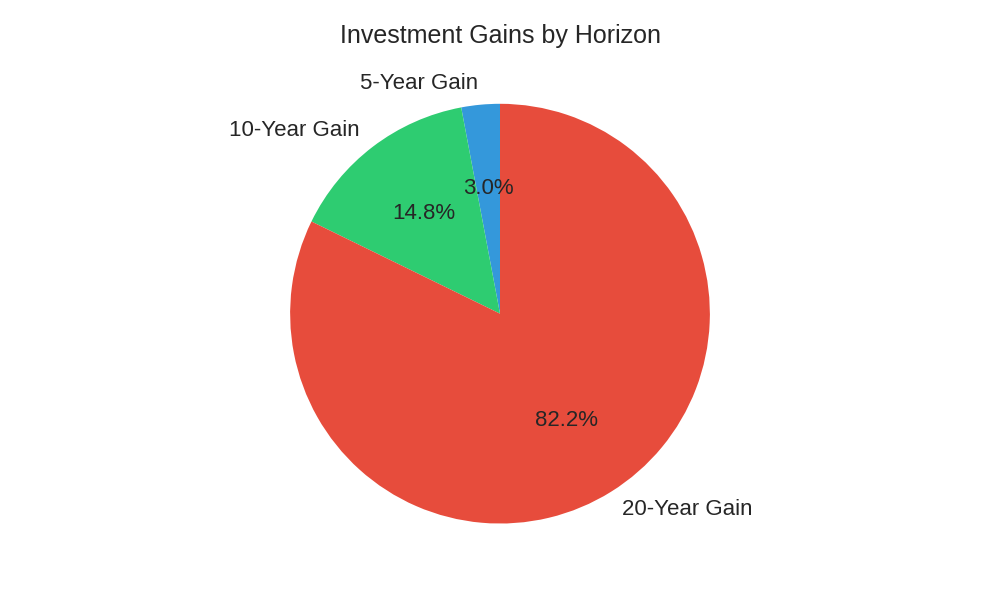
Compounding is arguably the most powerful force in investing. It means your earnings themselves earn returns, leading to exponential growth over time. The longer your money is invested, the greater the impact of compounding. This table illustrates how a consistent annual contribution can grow significantly.
| Investment Horizon | Total Contributions | Estimated Portfolio Value |
|---|---|---|
| Year 5 | $6,000 | $6,900 |
| Year 10 | $12,000 | $16,500 |
| Year 20 | $24,000 | $49,000 |
(Assumes an initial investment of $0, monthly contributions of $100, and an average annual return of 7%.)
Frequently Asked Questions (FAQ)
Is investing only for the wealthy?
Absolutely not. Many investing services, especially robo-advisors and online platforms, have low or no minimum investment requirements, making investing accessible to almost anyone. Starting small and consistently contributing is key.
How much money do I need to start investing?
You can often start with as little as $100, or even less with some platforms offering fractional share investing. The most important thing is to start early and invest regularly, even small amounts.
What is a “good” return on investment?
A “good” return is relative and depends on your risk tolerance and investment type. Historically, the stock market has averaged returns of around 7-10% annually over long periods, but past performance is not indicative of future results. It’s important to have realistic expectations.
Should I invest alone or use an investing service?
It depends on your knowledge, time availability, and comfort level. If you’re comfortable researching and managing your own portfolio, self-directed investing is an option. If you prefer guidance, automation, or comprehensive planning, an investing service can be invaluable. Educational resources from sites like Investopedia can help you learn more.
What is a fiduciary duty?
A fiduciary duty means an advisor is legally and ethically bound to act in your best interest. Always ask if your financial advisor operates under a fiduciary standard. This offers a higher level of protection than simply recommending suitable investments.

Conclusion
Securing your financial future through investing is a journey that rewards patience, consistency, and informed decision-making. By understanding your goals, assessing your risk, and selecting the right investing service, you can confidently navigate the financial markets. Remember, the earlier you start, the more time your money has to grow through the power of compounding.
Don’t let market jargon deter you. Take the first step today towards building a robust financial future. Explore reputable investing services, educate yourself on personal finance topics (perhaps by following financial news on platforms like Bloomberg), and consider consulting a qualified financial professional to tailor a plan that aligns perfectly with your unique aspirations.
Disclaimer: The information provided in this article is for educational purposes only and does not constitute financial advice.